
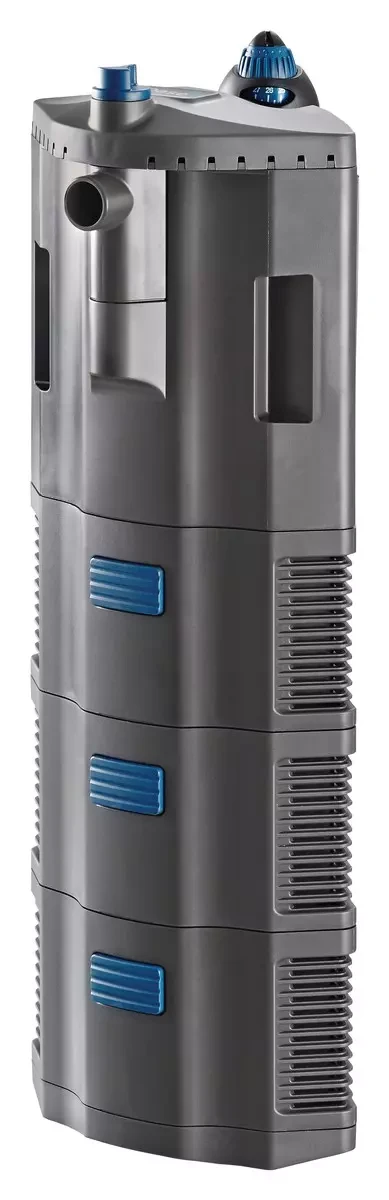
Your needs, this model
Does it fit your priorities?
Is a 55-gallon Thermo 200 label a complete numeric capacity range?
No. OASE publishes a 55-US-gallon upper limit and the family manual recommends one 55-gallon size, but the sources do not state a lower limit. The exact-volume finder therefore does not certify fit at 55 gallons from these facts alone.
Explore this need in the finder →Will the Thermo 200 work if there is no cabinet below the aquarium?
Its documented arrangement is an internal corner filter, so below-tank canister space is not required. That does not make it space-free: its published body is 13 inches high and the filter module must be reachable for service.
Explore this need in the finder →Is its 0.7 L value a media-basket capacity, and what heater is included?
OASE calls 0.7 L total filter volume; the page does not state a comparable media-basket volume. SKU 55157 bundles the HeatUp 200 heater (200 W) and specifies three 20-ppi foams plus carbon foam, but the page's 7 W filter-power claim differs from the family manual's 8 W table entry.
Explore this need in the finder →OASE's BioPlus Thermo 200 US filter (SKU 55157) is the tallest of the three currently observed BioPlus Thermo sizes. It combines the internal corner filter with the HeatUp 200 heater, a three-foam-stage package and a 55-US-gallon upper label. Those features make its intended equipment bundle clearer than the Thermo 50 and 100 pages, but they do not establish a lower capacity limit, a fish-load rating or a measured level of filtration. It is an internal unit, so the key physical constraint is the space it uses in the aquarium rather than a canister location under it.
Fit the tall body to an actual corner
The current exact US page gives body dimensions of 4.7 by 4.3 by 13 inches. The family manual lists the same height. Measure the usable corner with the hood, substrate, plants and nearby equipment in place, then leave the additional room needed to remove the filter components. A 13-inch object may be a poor fit in a shallow tank even when its gallon label sounds appropriate. The unit attaches with suction cups to a suitable smooth surface; its power cable and outlet orientation also need a safe path.
OASE labels this model for up to 55 US gallons and separately shows 200 L. The manual recommends one 55-gallon volume. That is not a documented two-ended interval: no lower capacity bound is given. The site's numeric finder therefore does not certify an exact 55-gallon match based on a ceiling alone. Nor does the page claim a safe fish count, unusual bioload, or service interval. Those decisions cannot be recovered by reading the number 200 as a universal guarantee.
What the Thermo 200 package adds
The exact SKU's US package page lists an integrated heater, three 20-ppi filter foams, a 30-ppi carbon foam, diffuser, suction cups and power cables. The exact aquarium page separately identifies the BioPlus 200 body (SKU 55154) and HeatUp 200 heater (SKU 33804) as the bundled components. OASE rates the heater at 200 W. This exact heater-and-filter configuration differs from standard BioPlus 200, which is not the same purchase package. If you compare the standard unit with a separate heater already on hand, verify both sets of instructions and compatibility rather than assuming the regular and Thermo model pages describe an identical box.
OASE describes an internal outlet/diffuser arrangement with adjustable settings and a choice of central outlet or nozzles. That supports planning where return water enters the tank, not a claim about actual circulation after the media, tank geometry and placement are considered. The current page reports 190 GPH and 650 L/h. The English table in the family manual also gives 190 GPH, while the manual's Spanish table prints 719 L/h. Keep those source labels separate; there is no measurement here showing how much water moves through a specific filled aquarium.
Power and maintenance: check the manual as well as the table
The exact product page's descriptive paragraph and split electrical row give 7 W for the filter plus 200 W for its heater. A separate duplicated “power consumption” field shows 208 W, which is not explained beside the split value. The official family manual instead lists an 8 W filter and a 200 W Thermo heater. Both sources identify 120 V / 60 Hz for the US version. I retain the conflict and do not state that either display is a measured operating draw. If a circuit, power supply or energy comparison makes the distinction important, confirm the exact current specification with OASE.
The manual says to disconnect the unit before work, keep the pump submerged, not run it dry and rinse filter media before its first use. Its cleaning section describes separating the filter and pump sections and advises against cleaning every foam piece at the same time. OASE's product page says the filter modules can be removed while the pump and heater remain in place for some cleaning tasks. These statements describe the maker's system and steps; they do not promise that removing a wet filter is clean or convenient in every aquarium cabinet or room layout. Plan a tray and safe way to handle the parts without pulling on live cables.
Volume is not basket size
The 0.7 L figure on the page is named filter volume, and OASE separately prints 0.17 US gal. It is not a media-basket volume. The media-basket field remains unknown, so the Thermo 200 cannot satisfy a hard request for a known basket capacity merely because 0.7 is a precise decimal. Three foam blocks and a carbon stage are useful package details, but media count and total filter-volume claims are not substitutes for a measured basket field. None of them supplies high-waste suitability.
OASE marks the model suitable for fresh and salt water; the family manual lists a 39–95°F aquarium-water range. The integrated heater is adjustable according to the product page, but the source material reviewed here does not provide a test of temperature accuracy, recovery time or control uniformity. Use its own heater instructions and verify the aquarium's needs instead of generalizing from the 200 W rating.
Comparing the 200 with adjacent models
The standard BioPlus 200 is the most direct package contrast: it shares the nominal filter size but lacks the integrated HeatUp 200 as sold, while the Thermo adds the heater and occupies the same family-specific corner format. The Thermo 100 has a shorter body, a lower upper label and a 100 W heater; the Thermo 50 is the shortest of the group. Those are concrete fit and equipment differences, not proof that the largest unit handles every stocking plan better. The BioCompact 50 is a different internal design and should be compared by its own body/package and evidence.
Checks before buying SKU 55157
Verify the exact BioPlus Thermo 200 US name/SKU, the HeatUp 200 bundle, the three 20-ppi foams and carbon foam, 120 V / 60 Hz, the 13-inch height, and a reachable smooth corner with service clearance. Ask the maker to clarify the 7 W versus 8 W filter value and the duplicated 208 W row if power is decisive. Treat 55 gallons as a ceiling and 0.7 L as total filter volume. The sources do not provide a lower range endpoint, a media-basket amount, a high-waste rating, measured installed flow, heating-accuracy data, noise measurement or a stocking recommendation. No hands-on test or personal use is represented in this assessment.
Key specifications
Key details at a glance
| Published range upper bound | 55 US gal |
|---|---|
| Filter volume (manufacturer label) | 0.7 L |
| Power draw at 120 V / 60 Hz | 7 W |
| Manufacturer-supported water types | freshwater / saltwater |
| US manufacturer item number | 55157 |
| Body length | 4.7 in |
| Body width | 4.3 in |
| Body height | 13 in |
| Manufacturer-listed outlet choices | OASE describes a central outlet/nozzle choice and three adjustable diffuser settings. They influence the outlet plan; they are not tested aquarium circulation values. |
| Manufacturer-listed included media | three 20 ppi filter-foam pieces / 30 ppi carbon filter foam |
| Maximum listed flow rate | 190 US GPH |
| Maximum listed flow rate (paired maker value) | 650 LPH |
| Adjustable flow control | Yes |
| Manufacturer aquarium-size claim | Exact US page labels up to 55 US gal and 200 L; the applicable family manual recommends one 55 US gal volume. No lower range endpoint is documented, and the labels are not treated as a conversion. |
Use the exact model’s instructions for operating limits, supplied equipment and version differences.
Sources for this review
Sources for this assessment
Start with your tank and installation constraints
Compare supported tank-volume intervals, external versus internal arrangements, installation space and media needs. An upper-only capacity claim cannot establish a complete volume fit, and the finder cannot infer your fish load.