
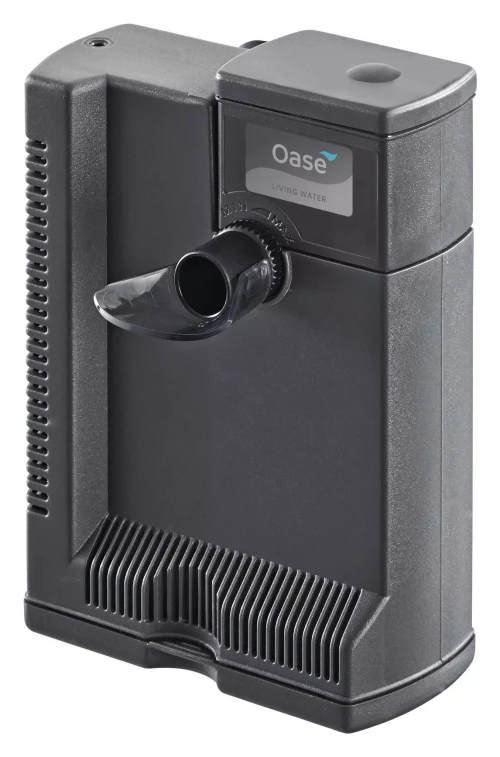
Your needs, this model
Does it fit your priorities?
What aquarium volume does the BioCompact 50 claim support?
The OASE US product page lists up to 15 US gallons and 50 L; the manufacturer comparison table recommends 15 gallons / 50 L. This is not a lower-and-upper interval, so the numeric finder does not treat it as a verified match at an exact tank volume.
Explore this need in the finder →Is BioCompact 50's flow rating settled across the OASE US pages?
No. The current OASE US model page states an adjustable 120–240 L/h range, while the OASE North America comparison table gives 60 GPH / 240 LPH for the 50 row. The sources do not reconcile the presentation, so compare installation and package facts rather than treating one figure as a measured aquarium circulation rate.
Explore this need in the finder →Does the 0.19 L BioCompact 50 filter volume meet a media-basket minimum?
Not on these sources. OASE calls 0.19 L the filter volume; it does not call it media-basket volume. Because the site finder asks for a maker-listed media-basket amount, this unknown field cannot satisfy that numeric condition.
Explore this need in the finder →The OASE BioCompact 50 is an internal freshwater filter in the same compact family as the 25, but its wider body, larger stated filter volume and different upper aquarium-size label make it a separate configuration to assess. The US product source identifies SKU 55142 and lists the model for up to 15 US gallons; the manufacturer comparison table separately recommends 15 gallons / 50 litres. As with the smaller unit, that maximum and singular recommendation do not establish a lower operating-volume boundary. The numeric matcher therefore does not certify an exact aquarium volume from this claim alone.
Choose the arrangement before the model number
Unlike an external canister, the BioCompact 50 sits inside the aquarium and does not need a cabinet, hose run or separate canister position. OASE describes horizontal and vertical installation, including shallow paludarium layouts. Its manufacturer-listed size is 3.3 × 2 × 4.6 inches, so it is wider than the 25 while remaining a compact in-tank device. The available aquarium volume is not the only dimension to check: make sure the body and outlet fit without obstructing plants, livestock movement or routine cleaning.
This format can address a location constraint when there is no below-tank space, but it moves the fit question into the aquarium. Compare the BioCompact 25 for a narrower body and lower maker ceiling, the Fluval U2 for a model with a documented two-ended volume range and three distinct outlet choices, or the Fluval Nano for another compact internal approach. These are different configurations, not evidence that their media, flow or capacity values can be interchanged.
Flow figures need a source check
The current OASE US model page describes a water-flow range of 120–240 litres per hour with adjustment at the diffuser. A separate OASE North America comparison table lists 60 GPH / 240 LPH for the BioCompact 50 row instead. The pages do not reconcile whether that table is older or whether its single figure represents a different operating point, so this assessment treats the model's flow presentation as unsettled rather than selecting the more impressive or convenient number. Neither source reports a verified circulation rate through an installed tank and supplied media.
That distinction matters in a small aquarium, where the outlet can influence surface movement and where some fish, plants or invertebrates may be affected by strong local flow. OASE's model page describes adjustable flow, but the correct setting still depends on the aquarium; the maximum label is not a measure of biological capacity or an instruction to maximize movement. Ask the maker to confirm the current manual and package if a specific flow range is decisive.
Capacity, media and maintenance
OASE describes the 50 as suitable up to 50 litres on its US product page, while the North American table gives 15 US gallons / 50 litres as the recommended size. Preserve those manufacturer labels as printed rather than treating the pair as a mathematical conversion or as a lower-and-upper range. The page does not document high-waste suitability. Stocking density, feeding, plant debris and species needs need a separate plan.
The North American table reports a 0.19-litre filter volume and a 115-volt, 60-hertz supply with a four-watt draw. Its package listing includes carbon filter foam, 20-ppi foam, a diffuser, suction cups and power cable. OASE also describes a chamber that can take other media. However, the maker calls the 0.19 L figure filter volume, not media-basket volume. This library's basket filter cannot count it toward a hard litre minimum, and the BioCompact 50 should not be compared on that basis with a canister whose media basket is explicitly sized.
Because the foam and carbon are different roles, plan replacements by exact SKU and keep biological media care consistent with the manual. The filter must remain reachable inside the tank; a tight aquascape can make removal more awkward than a product's exterior dimensions suggest. Do not infer that a BioCompact 25 replacement pad fits the 50 or vice versa.
Who should shortlist it
The strongest documented case is a small freshwater aquarium needing an internal, no-cabinet arrangement and an in-tank body that can be installed in either listed orientation. The stated 15-gallon ceiling provides a starting boundary, not an exact-volume match, a stocking recommendation or evidence of an unusually heavy-load rating. The conflicting flow presentations also limit any comparison based on turnover.
Before choosing, measure the intended installation spot, leave clearance for the intake and service, verify the exact US 55142 package and electrical supply, and check the current manual for safe operation and media care. If an exact aquarium-volume range or a documented media-basket minimum is essential, the available sources do not establish those capabilities for this model. In that case, keep the decision open rather than silently substituting its filter-volume figure or advertised maximum.
Primary references: OASE's US internal-filter catalogue, BioCompact 50 US product page, and the OASE North America BioCompact comparison table.
Key specifications
Key details at a glance
| Published range upper bound | 15 US gal |
|---|---|
| Filter volume (manufacturer label) | 0.19 L |
| Manufacturer-supported water types | freshwater |
| US manufacturer item number | 55142 |
| Body length | 3.3 in |
| Body width | 2 in |
| Body height | 4.6 in |
| Manufacturer-listed included media | carbon filter foam / 20 ppi filter foam |
| Manufacturer aquarium-size claim | OASE's US model page says up to 15 US gal and separately gives a 50 L maximum; the US manufacturer table recommends 15 US gal / 50 L. |
Use the exact model’s instructions for operating limits, supplied equipment and version differences.
Sources for this review
Sources for this assessment
Start with your tank and installation constraints
Compare supported tank-volume intervals, external versus internal arrangements, installation space and media needs. An upper-only capacity claim cannot establish a complete volume fit, and the finder cannot infer your fish load.