
Your needs, this model
Does it fit your priorities?
Does BioPlus 200's 55-gallon ceiling confirm an exact 55-gallon fit?
OASE lists up to 55 US gallons and the family manual recommends 55 gallons, but neither supplies a lower interval endpoint. The numeric matcher therefore leaves an entered volume unconfirmed for this maximum-only claim.
Explore this need in the finder →What changes in the BioPlus 200 package compared with the 50 and 100?
The exact US page lists a 30-ppi carbon foam, three 20-ppi foams, diffuser, suction cups and power cable. It remains a standard filter without a heater in the box; Thermo 200 is a distinct heater-included SKU.
Explore this need in the finder →Is the BioPlus 200's 0.7 L filter volume a basket specification?
No. The source labels it total filter volume and does not state a media-basket measurement. Also treat the flow and wattage wording carefully: the US page's body text differs from some table values, so check the exact manual rather than extrapolating from the 50 or 100.
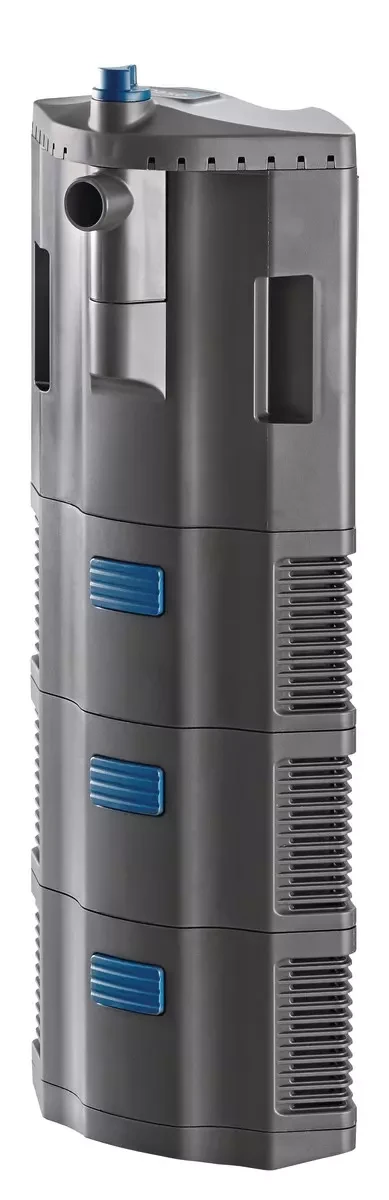
Explore this need in the finder →BioPlus 200 (US SKU 55154) is the largest standard member of OASE's three-size internal BioPlus group. Its 13-inch-tall corner body and three listed 20-ppi foam filters make the physical fit inside the aquarium a central question, not a minor detail. OASE gives it an up-to-55-US-gallon label and the family manual names 55 gallons as its recommended size. Neither statement supplies a lower operating-volume boundary or a fish-load rating.
The largest standard size has the largest internal footprint
The exact US page lists a body about 4.7 × 4.3 × 13 inches; the manual reports the same dimensions. The BioPlus 100 is 10.6 inches high, and the 50 is 8.3 inches in the manual (the 50 page itself lists 8 inches). The 200's 55-gallon ceiling should not be read as a statement that the unit is suitable for every smaller aquarium or every stocking level. The source's 200 L label is another printed value; it is not necessary to convert that label into a precise US-gallon equivalent.
As an internal filter, the 200 does not require a canister location under the stand, but it will occupy a corner inside the tank. OASE's family manual says to use the supplied suction cups on a clean, smooth surface and mount in an aquarium corner with the outflow just below the water surface. That location has to leave room for the housing and for removal during cleaning. It should also be measured against the real hood, aquascape and livestock rather than inferred from the gallon label.
Three foam modules, plus carbon foam
The standard box listing includes the filter, a 30-ppi carbon foam, three 20-ppi foams, an integrated diffuser, suction cups and power cable. The three foam stages distinguish this size from the two 20-ppi pieces in the BioPlus 100 and the single one in the BioPlus 50. OASE labels its overall capacity field as 0.7 L of filter volume. That number is not a documented media-basket volume, so it cannot satisfy a hard minimum for a filter basket measured in litres.
The filter section is designed to be separated from the pump section for maintenance. OASE's manual instructs the owner to disconnect power before removing or cleaning equipment, rinse the media before initial use, keep the pump from running dry and return the outlet below the water surface. This offers access to the filter modules without moving a canister outside the aquarium, but the unit is still an immersed assembly and servicing involves wet parts. No source here establishes how often a particular stocked aquarium would require cleaning.
Flow and power data need cautious reading
The BioPlus 200 product page and manual state a maximum 190 GPH; the page also lists 650 L/h. An alternate official OASE page route for the same SKU reports 170 GPH. The numerical units on the primary page do not convert consistently, and no published value here measures circulation after installation. The product's central outlet/nozzle choice is a practical placement feature, while OASE's promotional copy separately describes three diffuser flow settings. Confirm the relevant instructions if a precise flow limit is essential.
There is also a wattage discrepancy: the product page's short descriptive paragraph says 7 W, while its detailed US specification table and the family manual list 8 W. The latter two sources agree, so 8 W is what the fact sheet records, but the conflicting wording remains visible here. The manual identifies a 120 V / 60 Hz supply and 3.6-foot maximum head height. These are maker specifications, not measurements from a test.
Do not confuse standard BioPlus 200 with Thermo 200
SKU 55154 is the standard model, without an included heater. OASE says that a compatible HeatUp 200 can be installed separately. BioPlus Thermo 200 is a different model/SKU and package with the heater integrated. The family manual's size pairing and the separate heater instructions matter; a seller's generic “BioPlus” title is not enough to establish the package. The manual's stated water-temperature operating range is 39–95°F, not a recommendation for a particular species.
For a smaller or less intrusive corner body, compare BioPlus 100 and 50; the difference is physical height and supplied foam quantity as well as the size labels. BioCompact 50 is another internal filter with a different shape, but its total filter volume also should not be mistaken for media-basket capacity. None of these choices proves stocking suitability just by offering more foam or a larger ceiling.
When to shortlist it
BioPlus 200 belongs on a shortlist if an internal filter is the desired arrangement, the aquarium can accept the 13-inch body, and the supplied staged foam package is useful. It remains a weak answer to a request for a documented lower volume boundary, a high-waste endorsement or a litre basket measurement: those fields are not established in the reviewed sources. The matcher therefore allows the internal and no-cabinet choices but does not certify a numeric tank-volume answer or a basket minimum from its maximum label and total filter-volume figure.
Before buying, confirm SKU 55154, 120 V / 60 Hz compatibility, standard-versus-Thermo contents, the exact media and a safe removal route. If the conflicting flow or wattage wording affects a design decision, seek clarification from OASE rather than selecting whichever number looks preferable. This review is based on manufacturer material; it does not claim personal use, measured performance, customer sentiment, current price or stock.
Key specifications
Key details at a glance
| Published range upper bound | 55 US gal |
|---|---|
| Filter volume (manufacturer label) | 0.7 L |
| Power draw at 120 V / 60 Hz | 8 W |
| Manufacturer-supported water types | freshwater / saltwater |
| US manufacturer item number | 55154 |
| Body length | 4.7 in |
| Body width | 4.3 in |
| Body height | 13 in |
| Manufacturer-listed outlet choices | An outlet-control knob selects the central outlet or flow-out nozzles; OASE also describes three adjustable diffuser flow settings. The source does not establish a tested aquarium circulation rate. |
| Manufacturer-listed included media | 30 ppi carbon filter foam / three 20 ppi filter foams |
| Maximum listed flow rate | 190 US GPH |
| Maximum listed flow rate (paired maker value) | 650 LPH |
| Adjustable flow control | Yes |
| Manufacturer aquarium-size claim | OASE US product page: suitable up to a maximum of 55 US gal / 200 L; shared manual: recommended aquarium volume 55 US gal. The paired values are source labels, not an asserted exact unit conversion. No lower range endpoint is documented. |
Use the exact model’s instructions for operating limits, supplied equipment and version differences.
Sources for this review
Sources for this assessment
Start with your tank and installation constraints
Compare supported tank-volume intervals, external versus internal arrangements, installation space and media needs. An upper-only capacity claim cannot establish a complete volume fit, and the finder cannot infer your fish load.