
Your needs, this model
Does it fit your priorities?
Does the Thermo 100's 30-gallon limit prove an exact fit at 30 gallons?
It does not certify one under this finder. OASE's page calls 30 US gallons an upper label and the family manual gives it as one recommended size, but neither records a lower interval endpoint. The same numeric label should not be read as a stocking or waste-load rating.
Explore this need in the finder →Does the BioPlus Thermo 100 require a canister cabinet below the tank?
No. It is an internal corner filter on suction cups, so its documented plan does not require an under-tank location. Check the actual 10.6-inch body, aquarium-space impact, suitable smooth surface and removal path before choosing it.
Explore this need in the finder →Why do the Thermo 100 flow figures need an exact-model check?
The current expanded OASE US page and its family manual give 170 GPH, while a separate public rendering of the exact page says 130 GPH; the page/manual also show different paired metric values. These are conflicting maker claims, not a measurement of circulation through a filled aquarium.
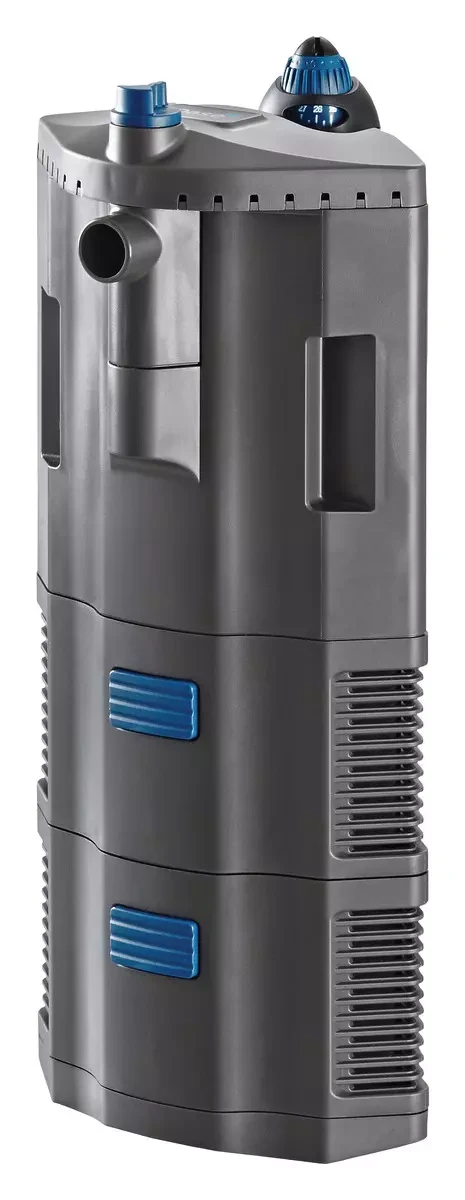
Explore this need in the finder →The US OASE BioPlus Thermo 100 (SKU 55156) is a corner internal filter sold with a HeatUp 100 heater (SKU 33802). Its 30-US-gallon upper label, 10.6-inch body and 100 W heater place it between the shorter Thermo 50 and the taller Thermo 200, but those size numbers do not constitute a performance ranking. The main question is whether an internal device and heater bundle suit the aquarium's actual layout and care plan, while leaving space for both water return and maintenance.
The volume label does not create a full interval
OASE's current US page lists an upper limit of 30 US gallons and separately prints 100 L. The applicable family manual recommends one 30-gallon aquarium size. It does not state a lower endpoint, so this is not a documented 10–30 or 20–30 gallon interval. In this review library, a numeric tank-volume request requires both bounds; the Thermo 100 therefore is not certified for an exact 30-gallon match on the strength of this ceiling alone. A maximum aquarium label also does not specify fish count, waste production, species needs or how maintenance frequency changes with the aquarium.
Its listed dimensions are 4.7 by 4.3 by 10.6 inches in both the exact product page and the family's technical table. Compare that body with the usable interior corner, not just the glass footprint. Leave the clear space needed to remove a filter module, and check whether the hood, waterline, hardscape and plants permit the intake and outlet arrangement described by OASE. The internal format avoids a below-tank cabinet requirement but consumes room inside the aquarium.
Outlet arrangement and conflicting flow claims
The exact page describes integrated outlet nozzles, a diffuser with adjustable settings and a choice between central outlet and nozzles. That can help when planning where the return stream should point. It does not establish the flow experienced after the foam, water depth and exact installation are taken into account. The currently expanded US page and the shared manual's English table state 170 GPH, while another public extraction of the same exact model page listed 130 GPH. The current US page says 500 L/h; the manual's Spanish technical table lists 644 L/h. These values do not line up as simple conversions. I keep the conflicting manufacturer's claims visible rather than selecting the higher figure as a test result.
OASE describes the filter module as removable while the pump unit remains in place for routine access, and the Thermo system keeps the heater integrated in the assembly. The family manual requires disconnecting power for service, keeping the pump submerged and not operating it dry. It also calls for rinsing media before first use and cautions against cleaning or replacing every foam piece at once. Use the current exact package instructions for the sequence; no hands-on service trial is claimed here.
Bundled heater and wattage labeling
The exact US model page's included-components section identifies the BioPlus 100 body (SKU 55153) and HeatUp 100 heater (SKU 33802). The heater is rated at 100 W, separate from the filter's pump draw. The product page describes 6 W for the filter and its split row states 6 + 100 W. A duplicated field label on the page also displays 106 W without explaining whether that is a combined value. The family manual independently lists 6 W for the filter and 100 W for the Thermo heater. This is an important package distinction from the standard BioPlus 100, which is not the heater-equipped SKU.
While the model is presented as a complete filter-and-heater set, the exact Thermo 100 page does not unambiguously enumerate every loose media piece in the box. It describes carbon foam, modular removable foam and a fine-filter chamber, and its component list names the filter and heater. Verify the exact retailer package before relying on a specific count or ordering replacements. Do not read the product's alternative-accessory list as a contents list.
What the half-litre field does and does not say
The exact page calls 0.5 L its filter volume and separately prints 0.13 US gal. Neither it nor the applicable manual identifies a media-basket capacity in litres. The finder keeps the basket field unknown rather than using the total filter-volume value to meet a hard basket minimum. This matters when comparing an internal sponge/module format with a canister whose manufacturer states basket volume: the two numbers describe different things and cannot answer the same question automatically.
The page lists freshwater and saltwater suitability, and the family manual specifies 39–95°F water for aquarium use. The page's “up to 30 gallons” and the heater's rated wattage do not by themselves settle a species' temperature requirements, flow tolerance or stocking density. Verify the HeatUp instructions and make sure its controls and electrical connection are right for the intended aquarium. The maker's general claims about quiet operation are not a decibel measurement.
Which neighbor is the relevant comparison?
Choose among the three Thermo sizes by exact body, included HeatUp model and package, not by assuming a larger numeral means a stronger match. Thermo 50 has the shortest body and HeatUp 50; Thermo 200 is 13 inches high and includes HeatUp 200. The non-Thermo BioPlus 100 has a similar nominal filter size but is a distinct package. If the heater is already planned separately, compare that standard filter's own instructions and supplied equipment rather than paying for or duplicating an integrated configuration. If aquarium space is the constraint, the internal BioCompact 50 is another distinct shape, not an equivalent package.
Practical checks before selecting SKU 55156
Confirm the exact US BioPlus Thermo 100 name/SKU, bundled HeatUp 100, 120 V / 60 Hz supply, body height and an accessible service route. Recheck the seller's box contents rather than inferring loose-media quantity from a related model. Treat 30 US gallons as an upper label, not a full operating interval; treat 0.5 L as total filter volume, not basket capacity. Ask OASE to resolve the published flow values and ambiguous page wattage field if they determine the decision. The available manufacturer records do not give a capacity lower bound, high-waste rating, media-basket amount, measured aquarium circulation, heating-accuracy result, actual noise level or tested maintenance schedule.
Key specifications
Key details at a glance
| Published range upper bound | 30 US gal |
|---|---|
| Filter volume (manufacturer label) | 0.5 L |
| Power draw at 120 V / 60 Hz | 6 W |
| Manufacturer-supported water types | freshwater / saltwater |
| US manufacturer item number | 55156 |
| Body length | 4.7 in |
| Body width | 4.3 in |
| Body height | 10.6 in |
| Manufacturer-listed outlet choices | OASE describes a central outlet/nozzle choice and three adjustable diffuser settings; this does not document installed aquarium circulation. |
| Manufacturer-listed included media | carbon filter foam is described by OASE; the exact Thermo 100 bundle page does not unambiguously enumerate loose-media quantities |
| Maximum listed flow rate | 170 US GPH |
| Maximum listed flow rate (paired maker value) | 500 LPH |
| Adjustable flow control | Yes |
| Manufacturer aquarium-size claim | Exact US page labels up to 30 US gal and 100 L; the applicable family manual recommends a single 30 US gal size. Neither source gives a lower range endpoint, and the two labels are not treated as a conversion. |
Use the exact model’s instructions for operating limits, supplied equipment and version differences.
Sources for this review
Sources for this assessment
Start with your tank and installation constraints
Compare supported tank-volume intervals, external versus internal arrangements, installation space and media needs. An upper-only capacity claim cannot establish a complete volume fit, and the finder cannot infer your fish load.