
Your needs, this model
Does it fit your priorities?
What aquarium-size claim is attached to EcoFlow 100 US SKU 94115?
The exact US table lists up to 26 US gallons and separately prints 100 L. It provides no lower endpoint. A generic family paragraph on the same page says up to 50 gallons for EcoFlow filters; that broad line conflicts with smaller model-specific ceilings and is not treated as this model's individual maximum.
Explore this need in the finder →What distinguishes the EcoFlow 100 from the smaller 60 size?
The exact pages list 100 up to 26 US gallons, 120 GPH maximum flow, 4.5 W, a 9.8-inch body height and 0.39 L filter volume; the 60 is listed up to 15 gallons, 90 GPH, 4.5 W, 8 inches high and 0.26 L. Neither total filter-volume figure is a media-basket amount, and both capacity statements lack a lower endpoint.
Explore this need in the finder →Does the 0.39 L EcoFlow 100 filter volume meet a basket-volume minimum?
No. OASE labels 0.39 L as filter volume and does not supply a comparable media-basket volume on the exact US model page. Unknown basket capacity cannot meet an essential litre threshold.
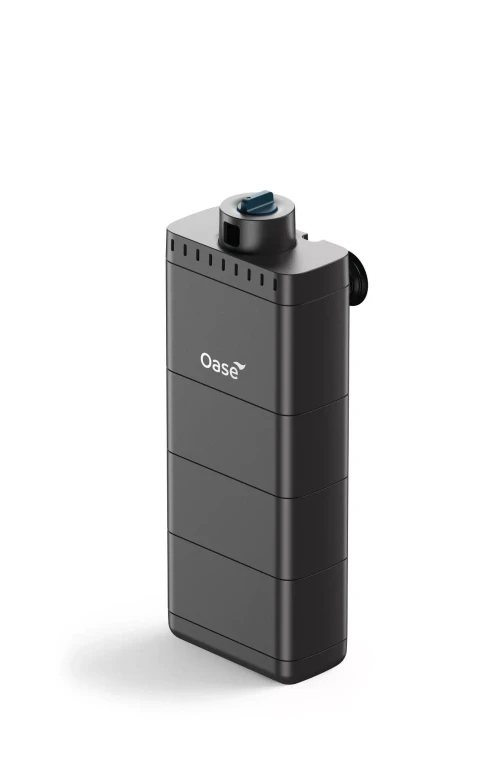
Explore this need in the finder →OASE's US EcoFlow 100 page identifies SKU 94115 and lists the filter for aquariums up to 26 US gallons, with 100 L printed separately. The specification table gives a maximum output of 120 GPH / 450 L/h, 4.5 W at 120 V / 60 Hz, a 3.7 × 2.6 × 9.8 inch housing and 0.39 L of filter volume. These figures distinguish it from the shorter EcoFlow 60 and taller 150/200 models, but they do not say how the filter will perform in a particular stocked aquarium. The capacity statement is a maximum only; no minimum interval endpoint is documented.
A middle size still needs an internal-space check
The EcoFlow 100 stays inside the aquarium rather than requiring a separate canister and cabinet location. That can suit rooms where an external installation is not wanted, but the 9.8-inch body claims space in the tank and needs a safe position for its intake, outlet and removal path. OASE describes a bracket and suction cups for mounting; its magnetic catches allow the filter module to lift out while the pump stays in place. That is potentially useful when servicing around a scape, provided the unit can actually be reached without moving decor or disturbing livestock.
Do not choose by the “100” name alone. In the same US line, the EcoFlow 60 is listed up to 15 gallons with 90 GPH, 4.5 W, an 8-inch height and 0.26 L filter volume. The 100 moves to a 26-gallon ceiling, 120 GPH, 9.8 inches and 0.39 L while keeping the same listed wattage. The 150 is not a simple step up in height: its page lists 8 W and a 40-gallon ceiling. The 200 is taller still and has its own set of claims. Check the exact model's dimensions and electrical details instead of treating the number as a complete compatibility label.
Media stages and outlet setup
OASE describes the EcoFlow 100 as using BioPearls for biological media and a 20-ppi foam for mechanical filtration. The exact page also describes adjustable flow direction and rate, a top nozzle, integrated spray bar, and a Venturi attachment for additional surface oxygenation. The visitor or installer must choose an outlet arrangement that suits the actual tank; the source copy's options are not evidence that all outlet modes operate simultaneously or provide a particular current. The maker's 120 GPH figure is a listed maximum, not an aquarium-side circulation measurement.
The page says the filter's removable chambers are designed to retain organic material during servicing, but this is a feature description, not a guarantee that cleaning will be spill-free in every installation. Keep the unit accessible, review the current instructions for maintenance and media handling, and avoid assuming that its model name or maximum-flow label predicts a maintenance interval. The page calls 0.39 L “filter volume.” It does not publish a media-basket figure, so the total volume cannot meet the site's minimum-basket question. That distinction matters when comparing this internal design with a canister that reports a separate basket amount.
How to read the tank-size statement
There is a genuine source tension to preserve: the EcoFlow 100's specific US table says up to 26 US gallons / 100 L, while a general paragraph on the exact page says EcoFlow filters are suitable up to 50 gallons / 200 L. I use the specific 100 table as the model-level maximum and do not assign the family-wide line as this model's individual rating. Neither text provides a lower tank-size endpoint. Therefore, the finder does not certify an exact volume for this filter just because it is under 26 gallons. The printed 100 L should also remain the maker's paired label, not be treated as a mathematically derived gallon conversion or a recommendation for every stocking level.
Neither the page nor its displayed specifications gives a high-waste or fish-count rating. Feed quantity, species, habitat flow, water changes and how the tank is established need separate consideration. A ceiling and adjustable outlet do not answer those questions.
Decision summary
The 100 merits comparison when an internal layout is intended, there is space for a nearly 10-inch body and the specific US electrical version is appropriate. Verify SKU 94115, package and manual; measure clearance around the tank rather than relying on a tank-volume label. If you require proof of fit at one precise aquarium volume, a published basket minimum or explicit high-waste support, these current OASE pages do not establish those facts. This is a manufacturer-source assessment, not a hands-on or laboratory review.
Primary references: the exact OASE EcoFlow 100 US page and the OASE US Internal Filters catalogue, with same-family pages for 60, 150 and 200. Sources checked 2026-10-30; no aquarium tests were performed.
Key specifications
Key details at a glance
| Published range upper bound | 26 US gal |
|---|---|
| Filter volume (manufacturer label) | 0.39 L |
| Power draw at 120 V / 60 Hz | 4.5 W |
| Manufacturer-supported water types | freshwater / saltwater |
| US manufacturer item number | 94115 |
| Body length | 3.7 in |
| Body width | 2.6 in |
| Body height | 9.8 in |
| Manufacturer-listed outlet choices | OASE describes adjustable flow direction and rate, a top outlet/nozzle and integrated spray-bar choice, plus a Venturi nozzle attachment; use the exact installed outlet arrangement appropriate to the tank. |
| Manufacturer-listed included media | 20 ppi mechanical filter foam / BioPearls for biological media |
| Maximum listed flow rate | 120 US GPH |
| Maximum listed flow rate (paired maker value) | 450 LPH |
| Adjustable flow control | Yes |
| Manufacturer aquarium-size claim | The exact US model table lists up to 26 US gal and 100 L, without a lower endpoint. The same exact page also carries generic family copy saying EcoFlow filters are suitable up to 50 gal / 200 L; that generic statement does not replace this model-specific table. |
Use the exact model’s instructions for operating limits, supplied equipment and version differences.
Sources for this review
Sources for this assessment
Start with your tank and installation constraints
Compare supported tank-volume intervals, external versus internal arrangements, installation space and media needs. An upper-only capacity claim cannot establish a complete volume fit, and the finder cannot infer your fish load.