
Your needs, this model
Does it fit your priorities?
Does the BioPlus 100's up-to-30-gallon label form a full operating range?
No lower limit appears in the exact US page or family manual. Thirty gallons is the page ceiling and the manual's single recommended size, not a verified interval from a lower to an upper boundary.
Explore this need in the finder →What is supplied with the standard BioPlus 100?
OASE lists a 30-ppi carbon foam, two 20-ppi foams, an integrated diffuser, suction cups and a power cable. The standard 55153 package is not the heater-equipped Thermo 100; verify the SKU and contents on any listing.
Explore this need in the finder →Can I use 0.5 L as the BioPlus 100's media-basket volume?
No. OASE calls that number filter volume, while the sources do not identify a media-basket capacity for this internal module. A hard basket-minimum answer stays unverified rather than treating total filter volume as a basket.
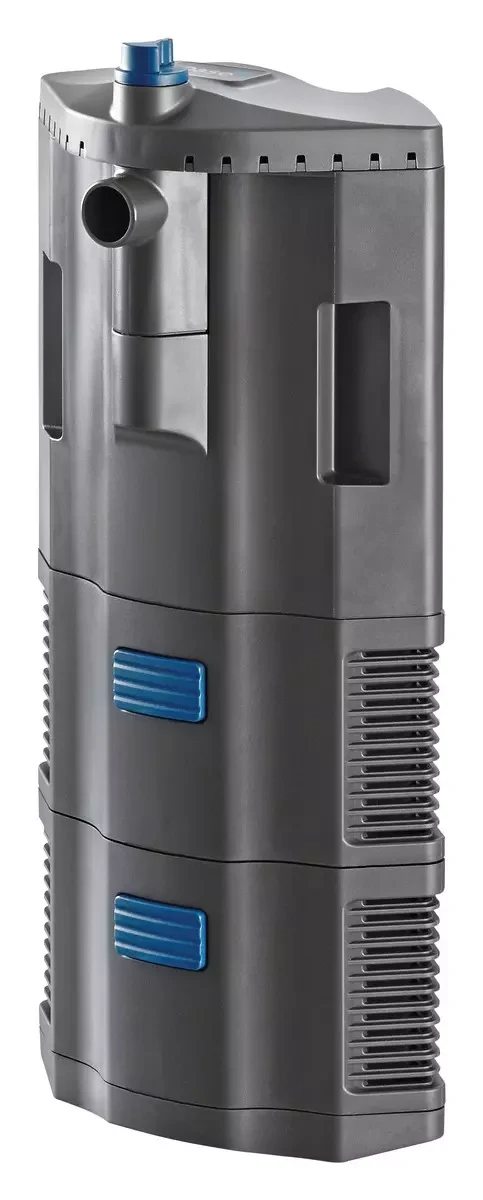
Explore this need in the finder →The BioPlus 100 is the middle standard size in OASE's internal BioPlus line, identifiable in the US as SKU 55153. It keeps the same corner suction-cup arrangement as the 50 and 200 but adds a second 20-ppi foam stage and a taller 10.6-inch housing. That makes the physical envelope and service path more consequential than the family name alone suggests. OASE's published 30-US-gallon maximum is a starting label, not a guarantee for a particular stocking plan or a complete numeric range.
A mid-size internal body still uses tank space
OASE calls this a corner internal aquarium filter and lists it up to 30 US gallons; the page also prints 100 L, while the family manual gives 30 gallons as a recommended aquarium volume. No lower volume endpoint is supplied. The matcher therefore treats this as a documented ceiling/recommendation rather than assuming the filter is proven suitable at every smaller exact volume. Tank volume is also not fish count: the manufacturer material does not give a high-waste or unusual-stocking validation.
The body measures 4.7 × 4.3 × 10.6 inches in the product-page table and manual. That height is notably greater than the BioPlus 50's manual-listed 8.3 inches, with the 200 extending to 13 inches. Measure the intended corner from the waterline and account for the assembly's removal path. It avoids a dedicated below-tank canister position, but its in-tank footprint remains real. The manual calls for suction cups on a clean, smooth surface, placement in an aquarium corner, and an outlet just beneath the water surface.
How its media and outlet are arranged
The US page lists two 20-ppi foam filters, a 30-ppi carbon foam, a diffuser, suction cups and a power cord. The count of foam stages is a concrete distinction from the one listed 20-ppi foam in the BioPlus 50 and the three in the BioPlus 200. OASE also sells compatible replacement media, but a separate accessory listing should not be confused with the contents of the standard SKU 55153 package.
The water outlet can be directed through the central outlet or through the nozzles, according to the family manual; OASE's feature text separately describes three adjustable diffuser flow settings. The current page and manual state maximums of 170 GPH and 500 L/h. Those paired units do not express an exact conversion, and neither is a measured aquarium circulation result. Use the nozzle arrangement as an installation choice, not proof of flow under the eventual media, tank depth and plumbing conditions.
What the 0.5 L field measures
OASE lists 0.5 L as filter volume. That is not the same thing as a manufacturer-listed media-basket capacity, so it cannot be compared directly with the litre basket values published for some external canisters. The 100's package has discrete foam pieces rather than a stated litre basket amount. If an essential requirement is a specific basket volume, this model is an unknown, not a verified match and not necessarily a physical zero.
OASE describes the filter module as removable while the pump unit can remain in place. The manual gives a more exact maintenance picture: disconnect power, take the assembly out as instructed, separate and clean the modules, rinse media before initial use and never allow the pump to run dry. That design may help someone who wants access to the foam stage without servicing a cabinet canister, but it still involves lifting a wet internal assembly out of the aquarium.
Standard BioPlus versus BioPlus Thermo
The 55153 standard package does not include a heater. OASE states that a compatible HeatUp 100 can be fitted separately, while BioPlus Thermo 100 is a distinct SKU with an integrated heater. Do not treat them as identical packages just because they share a filter module. The manual's model-specific pairing table governs which HeatUp size goes with which tank/filter size. It also restricts the operating water temperature to 39–95°F; use the heater's own instructions for temperature setting and wiring details.
The technical table and manual agree on 6 W for the filter at 120 V / 60 Hz. They do not make this a measured noise or efficiency review; OASE's quiet-operation language is a manufacturer description. The manuals and pages do not provide a bioload rating, media-basket measure or minimum aquarium volume. The sensible comparison is about fit, space, foam-stage count, supplied equipment and service—not an unsupported claim that a bigger number guarantees healthier water.
Where it sits among the three sizes
Choose the BioPlus 100 for comparison when the exact standard US version, 30-gallon upper label and 10.6-inch corner body match the installation constraints. Compare the 50 if a shorter body and one 20-ppi foam are more appropriate, or the 200 if its 13-inch body and three 20-ppi foams are acceptable. These are distinct products and not a ranking. A BioCompact model presents another internal approach with its own dimensions and package; it does not establish that the BioPlus will fit a narrow aquascape.
Before purchase, check that the listing states BioPlus 100 SKU 55153 rather than Thermo 100, verify the exact US electrical rating and supplied foam pieces, and measure the aquarium corner including a route for removal. If flow units or an exact capacity interval matter, ask OASE to reconcile the claims and consult a species-specific aquarium professional. This assessment uses published material only; it does not claim personal installation, water testing, measured flow or firsthand maintenance.
Key specifications
Key details at a glance
| Published range upper bound | 30 US gal |
|---|---|
| Filter volume (manufacturer label) | 0.5 L |
| Power draw at 120 V / 60 Hz | 6 W |
| Manufacturer-supported water types | freshwater / saltwater |
| US manufacturer item number | 55153 |
| Body length | 4.7 in |
| Body width | 4.3 in |
| Body height | 10.6 in |
| Manufacturer-listed outlet choices | An outlet-control knob selects the central outlet or flow-out nozzles; OASE also describes three adjustable diffuser flow settings. The source does not establish a tested aquarium circulation rate. |
| Manufacturer-listed included media | 30 ppi carbon filter foam / two 20 ppi filter foams |
| Maximum listed flow rate | 170 US GPH |
| Maximum listed flow rate (paired maker value) | 500 LPH |
| Adjustable flow control | Yes |
| Manufacturer aquarium-size claim | OASE US product page: suitable up to a maximum of 30 US gal / 100 L; shared manual: recommended aquarium volume 30 US gal. The paired values are source labels, not an asserted exact unit conversion. No lower range endpoint is documented. |
Use the exact model’s instructions for operating limits, supplied equipment and version differences.
Sources for this review
Sources for this assessment
Start with your tank and installation constraints
Compare supported tank-volume intervals, external versus internal arrangements, installation space and media needs. An upper-only capacity claim cannot establish a complete volume fit, and the finder cannot infer your fish load.