
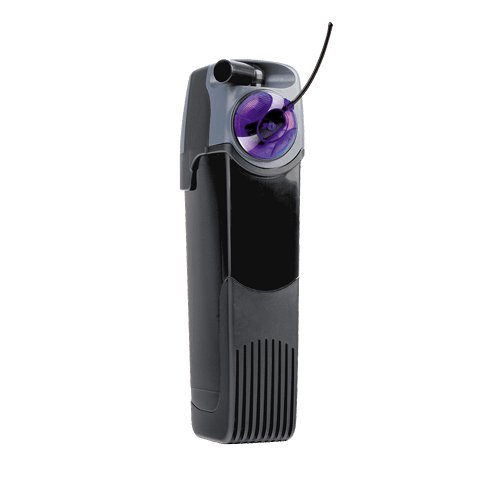
Your needs, this model
Does it fit your priorities?
Does this model avoid the need for a below-aquarium canister position?
Yes as a documented arrangement: Aquael describes the UNIFILTER UV as an internal filter with an in-tank holder; the manual requires the body to sit below the waterline while the aeration regulator stays above it. It still takes up tank space and needs removal/service clearance. The exact US page says this model is not available in the USA yet, so this is not a current US buying match.
Explore this need in the finder →What volume label does Aquael publish for the 750 size, and is that a waste-load guarantee?
The exact US-localized page pairs 52–79 US gallons with 200–300 L and lists maximum flow 198 GPH / 750 L/h. These maker figures are not fish-count or high-waste guidance; the older generic manual disagrees on power and the 500 lower metric endpoint. The page says not available in the USA yet.
Explore this need in the finder →What is unusual about this filter’s UV LED and sponge service arrangement?
Aquael describes a UV LED module that can be switched independently of filtration and two separate sponge cartridges that can be cleaned in turns. Its manual warns against running the UV LEDs outside the filter housing or looking at them; it gives only a conditional service-life estimate. The page is not a US retail offer.
Explore this need in the finder →The Aquael UNIFILTER 750 UV POWER is a distinct powered internal-filter size, listed as Art. nr. 107403 on the manufacturer’s US-localized product page. That same page says “NOT AVAILABLE IN USA YET,” so this is a reference assessment, not a current US recommendation or a route to a BuyerShortlists purchase page. The table groups the 750 between the 500 and 1000, but it has its own flow, dimensions, output, power and immersion figures; a family label is not a substitute for those exact differences.
The middle size occupies an overlapping label range
Aquael’s US page assigns the 750 a 52–79 US-gallon interval, paired with 200–300 L, plus 198 US gal/h / 750 L/h maximum flow and 8 W. The linked multilingual manual reports a 200–300 L tank-volume line, 750 L/h maximum output and 9 W. Thus the metric tank label and flow agree, while the power entry differs by 1 W. The page-paired volume is a manufacturer guideline, not a tested tank-load limit, and neither flow figure is an installed circulation measurement. Aquael does not publish a fish-count, high-waste or minimum-flow rating for this exact row.
There is meaningful overlap at each neighboring size boundary: the 500 ends at 52 gallons, where the 750 begins, and the page’s 750 and 1000 intervals overlap from 66 through 79 gallons. This does not show which one is “enough” for a particular livestock load. It only shows how the maker has drawn the labeled bands on this page. The 500’s lower interval also differs between its exact US page and the older manual, a source limit described in the 500 assessment; the 750 has its own stated band, not a guarantee borrowed from the adjacent size.
UV feature and safety boundaries
The 750 combines mechanical filtration and aeration with an integrated UV LED module. Aquael describes the LEDs as independently switchable and says their use is intended to reduce suspended algae, protozoa and bacteria while supporting water clarity. The source does not establish a disease-treatment result or promise that a particular tank will clear. The 2018 manual warns that UV radiation can injure eyes and skin; it says not to power the UV unit outside its filter housing and not to stare at the illuminated LEDs. Keep that distinction visible when considering “UV” claims: an included feature is not an independent efficacy test.
The manual’s service note says that, under its assumed normal aquarium conditions, the LEDs may lose about 20% of their output after 10,000 hours. It qualifies that estimate by water temperature and supply-voltage conditions and leaves replacement to the user’s observation. This is not a guaranteed replacement interval. The manual identifies the separate module family part number 107401 for the 750 and 1000; it does not establish a current US replacement-module offer.
Interior mounting, water level and space
This filter hangs inside the aquarium using the manufacturer’s bracket and suction-cup support. The manual says the upper edge of the motor body must remain below the surface while the aeration regulator stays out of the water, and it lists a 25 cm maximum immersion depth for the 750. The US page gives nominal dimensions of 2.4 × 4.4 × 10 inches / 6.7 × 11.2 × 25.5 cm; its 2.4-inch and 6.7-cm width figures are not direct conversions, so treat them as separate printed values and verify the actual body. These are stated dimensions, not installation clearances; check the actual hood and aquascape. The unit avoids a below-tank canister position but still takes up space inside the tank and needs room for sponge removal and impeller/UV service.
Its outlet can be redirected by up to 90 degrees, and output is adjustable, which may help set the return direction. The page does not give a numeric minimum flow or decibel figure. The larger 500, 750 and 1000 models are described as having a ceramic rotor axis for quieter operation, but no measured quietness comparison is supplied.
Media and package limits
The family uses two separate sponge cartridges; Aquael recommends cleaning them alternately rather than both together. The manual directs users to rinse the cartridge in removed aquarium water and periodically clean the rotor chamber and UV-module lenses, without soap, dish liquid or solvents. It lists sponge insert part 00086 for both the 750 and 1000. The manual lists optional 750 BIO container part 02528; the exact US page marks the family expandable but does not confirm a separate US accessory offer or the 750 package. No litre-rated media-basket amount is stated, so “expandable” is not a quantified media-capacity claim.
The product-page dimensions include both inch and centimeter fields; they should be treated as nominal published figures rather than a required installation clearance. The linked manual lists a 1.5 m power cord and 220–240 V / 50 Hz, but describes European safety-standard scope. Because the exact US page marks the family unavailable in the USA, those values do not verify a North-American plug, electrical edition or retail box. The page’s 8 W conflicts with the manual’s 9 W. None of these values should be “fixed” by guessing which configuration a future seller may supply.
Who should treat this as a useful reference
The 750 occupies a middle position in the family’s stated size table and has the distinct 750 L/h maximum-flow label, two cleanable sponges, adjustable output and integrated UV LED module. Its practical constraint is that all of those features are described on a page that explicitly does not offer the model in the United States yet; its exact US package and electrical nameplate remain unknown. Compare it with the 500 and 1000 to see the published range and chamber differences, but do not infer a stocking fit from gallons or flow. For the present US finder, the 750 remains reference-only and is excluded from current matches until an exact, dated US offer and configuration are established.
Key specifications
Key details at a glance
| Published range lower bound | 52 US gal |
|---|---|
| Published range upper bound | 79 US gal |
| US manufacturer item number | 107403 |
| Body width | 2.4 in |
| Body height | 10 in |
| Manufacturer-listed included media | Two separate sponge filter cartridges (manufacturer page) |
| Maximum listed flow rate (paired maker value) | 750 LPH |
| Adjustable flow control | Yes |
Use the exact model’s instructions for operating limits, supplied equipment and version differences.
Sources for this review
Sources for this assessment

Start with your tank and installation constraints
Compare supported tank-volume intervals, external versus internal arrangements, installation space and media needs. An upper-only capacity claim cannot establish a complete volume fit, and the finder cannot infer your fish load.