
Your needs, this model
Does it fit your priorities?
What does the current US MULTIKANI 1000 package include?
Aquael identifies item 135128 and says the standard set includes one 1.3 L chamber with mechanical sponge; as many as three further chambers are optional additions. Confirm the exact listing rather than assuming that four chambers or the media-filled modules are in the box.
Explore this need in the finder →Can the finder confirm a MULTIKANI 1000 fit for a specific tank volume?
Not from the current sources. The US page and leaflet say 25–400 L, while the linked English manual's opening paragraph and its suggested-module table disagree on the ranges and module counts. The exact item 135128 numeric endpoints remain unknown, so entering a volume does not make it a certified finder match.
Explore this need in the finder →Does the standard MULTIKANI 1000 start itself or run above the aquarium water level?
Aquael's linked current manual requires the filter below aquarium water level and says to fill the unit manually before first startup. Its specification table does not claim self-priming. The older MULTIKANI 800's placement options belong to a separate pump and should not be carried over.
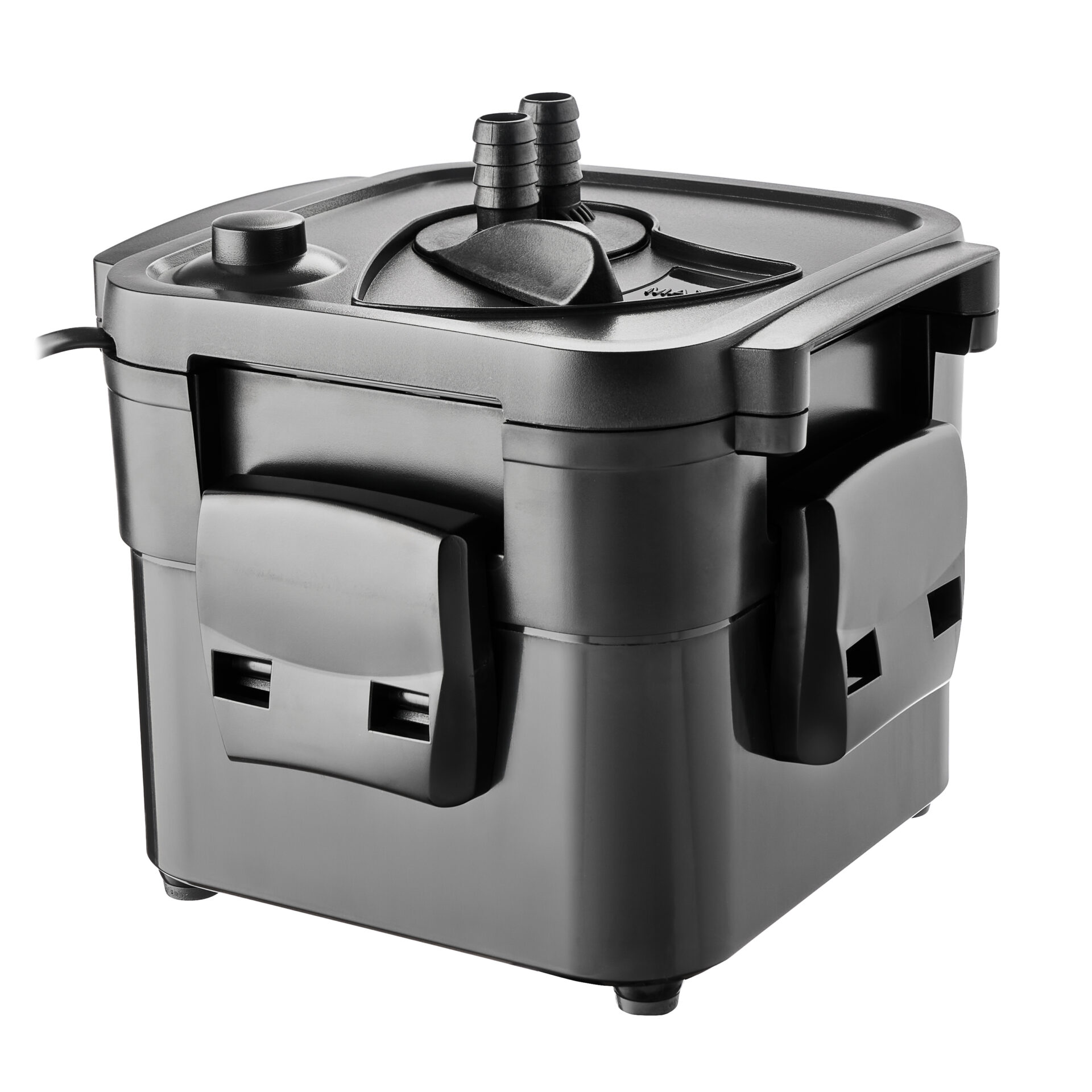
Explore this need in the finder →The Aquael MULTIKANI 1000 is a modular external filter built around a powered control unit and a standard 1.3 L media chamber. Aquael's US page identifies item 135128, a maximum pump output of 1,000 L/h, 9.1 W, 14/18 mm hoses and a 120 cm maximum-head label. These are manufacturer figures, not measured flow through an installed, media-loaded aquarium. The base set is not the four-chamber system shown in some modular illustrations: Aquael says one chamber is included and up to three more are sold separately.
One model row, not two configurations
The current Aquael US page's version table prints MULTIKANI 1000 / item 135128 twice, with the same aquarium range, dimensions, power, head, hose, chamber and control entries. It does not identify a second finish, bundle, pump or functional version. This assessment treats those repeated lines as one exact product identity rather than manufacturing a duplicate model. The table also lists four separately sold module options; those are media chambers, not additional powered filters.
The preceding US archive page names a different MULTIKANI 800, item 115089. Its earlier pump, chamber size, hose specification and installation options are distinct. Do not assume the 800's above-waterline placement or eight-basket architecture applies to the 1000, and do not infer shared part fit from the family name.
Capacity is configuration-dependent, and the sources conflict
Aquael's US product page and linked English leaflet describe a 25–400 L system and say that the main set comes with one 1.3 L chamber. The leaflet labels the 400 L upper end as a four-module setup, while three additional chambers are sold separately. The current page's broad range does not map a particular tank size to the exact chamber count in a seller's box.
The linked English manual makes the uncertainty more important: its introductory paragraph gives one-module capacity as 100–400 L and later expansions as 200–500, 300–600 and 400–700 L; the manual's own suggested-chamber table instead lists one chamber for 20–100 L, two for 100–200 L, three for 200–300 L and four for 300–400 L. Those are incompatible endpoints and configuration labels. I do not choose one set as the verified range for item 135128. The finder therefore leaves this model out when a shopper enters a numeric tank volume, rather than turning contradictory system-level claims into a confident exact-package match. Confirm the number of included and separately purchased chambers for the exact offer and consult Aquael about the intended range before relying on it.
Chamber volume is not the same as total system capacity
The standard unit has one 1.3 L media chamber. Up to three further chambers can be stacked between the cover and the standard container, for a four-chamber total; each extra chamber adds its own 1.3 L of media space. Aquael lists an empty module, a BioCeramax 600 version, a Carbomax version and a Zeomax version. The exact page and linked manual disagree on the item numbers for the three media-filled modules (132162/132164/132163 on the page versus 135162/135164/135163 in the manual). Treat that as an offer-check issue, not proof of a separate powered size. The site page says mechanical sponge is included; it does not establish that the optional biological or chemical chambers are in the base carton.
Aquael describes the 1,000 L/h pump output as a maximum and reports 9.1 W in its current US page and leaflet, but 9.2 W in the linked manual. The main chamber is listed as 21 × 21 × 21 cm. Neither the power figure nor the large system-volume headline is a stocking-density or high-waste rating. The checked pages do not provide such a rating, and the US product page does not state the exact AC input voltage and frequency of a retail unit.
Plan below-waterline placement and a manual start
This current 1000 configuration is not a flexible above-tank alternative. Its manual says the filter must be below aquarium water level; the suggested aquarium cabinet is below the tank. The page lists a 120 cm maximum head, but that is not permission to ignore the manual's placement instruction. Measure the cabinet opening, body footprint, hose route and room to remove a wet chamber before ordering. The listed hose diameters are 14/18 mm, so verify that any existing plumbing really fits those connections.
First startup also takes more than connecting the plug: Aquael instructs the user to fill the filter by hand, connect the hoses, set the control as directed, power the unit and gently move it to vent trapped air. The exact sequence should be followed from the manual; the page's specification table marks a self-priming mechanism with a dash. The control can adjust performance, and Aquael advertises an Aqua Stop service arrangement, but the manual warns that disconnecting the control kit while running can cause leakage. Treat the quick-disconnect claim as a maintenance aid, not permission to detach live connections casually.
Maintenance and media planning
Aquael says to unplug before maintenance, open the chamber with its clips, remove the media baskets and wash cartridges in water drained from the aquarium rather than tap water. The manual calls for routine filter and impeller-chamber attention at least every six months; it separately suggests at least monthly attention for modules holding Carbomax, Zeomax or Nitromax media. Those are manufacturer instructions, not measured service intervals. Added modules increase capacity but also add purchase cost, extra joints and more media to manage. No single module choice replaces matching media to the tank's actual waste and livestock needs.
Who should compare it—and what to verify
The MULTIKANI 1000 is worth comparing when an external canister below the waterline is practical, a compact stackable chamber system is genuinely useful, and the owner is comfortable checking a modular package rather than assuming every pictured chamber is included. Its chamber-by-chamber design offers a different expansion approach from a fixed multi-basket canister, but it does not establish that the filter will suit a particular fish load or habitat flow.
Before buying, verify item 135128, the standard chamber count, the correct extra-module codes and media, the power-supply nameplate, and the tank-volume configuration Aquael intends. The broad page range is not used as a numeric fit claim here because the linked manual conflicts with both the page and itself. This is a source-based assessment, not a hands-on test; no claim of ownership, measured noise or aquarium-side flow is made.
Primary references: Aquael's US MULTIKANI 1000 page, the linked operating manual, the English information leaflet, the module manual and Aquael's separate US archive page for the 800, checked 2026-11-01.
Key specifications
Key details at a glance
| Media-basket volume | 1.3 L |
|---|---|
| US manufacturer item number | 135128 |
| Manufacturer-listed included media | mechanical filter sponge |
| Maximum listed flow rate (paired maker value) | 1000 LPH |
| Adjustable flow control | Yes |
Use the exact model’s instructions for operating limits, supplied equipment and version differences.
Sources for this review
Sources for this assessment
- Aquael US External filters family-card snapshot
- Aquael US MULTIKANI 1000 page and versions/parameters table
- Aquael MULTIKANI 1000 multilingual operating manual, English sections
- Aquael MULTIKANI 1000 English information leaflet
- Aquael MULTIKANI 1000 filter-module manual
- Aquael US MULTIKANI archive page and MULTIKANI 800 model table
Start with your tank and installation constraints
Compare supported tank-volume intervals, external versus internal arrangements, installation space and media needs. An upper-only capacity claim cannot establish a complete volume fit, and the finder cannot infer your fish load.