
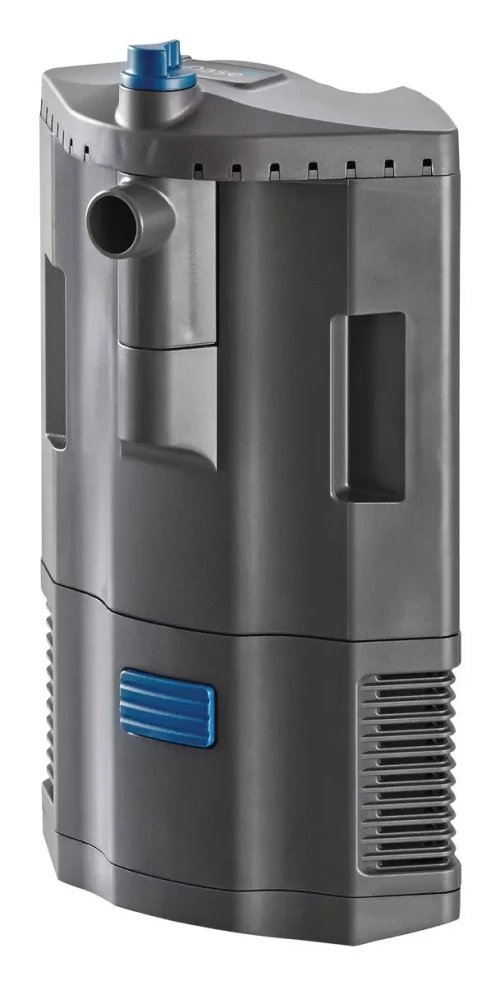
Your needs, this model
Does it fit your priorities?
Does the BioPlus 50's 15-gallon label certify a 15-gallon tank fit?
OASE lists an up-to-15-US-gallon label and the manual recommends 15 gallons, but neither supplies a lower interval endpoint. The numeric finder therefore cannot certify an exact 15-gallon match from this claim alone.
Explore this need in the finder →Can BioPlus 50 work without a below-aquarium canister cabinet?
Yes, its supported arrangement is an internal corner filter on suction cups, so no below-tank canister spot is required. It still needs enough clear aquarium space and a safe route for removing the filter module and pump during service.
Explore this need in the finder →Is 0.3 L the BioPlus 50's media-basket capacity?
No. OASE calls 0.3 L the total filter volume. The reviewed sources do not state a litre media-basket capacity, so that figure cannot verify a hard basket-volume minimum.
Explore this need in the finder →OASE's standard BioPlus 50 is the shortest of the US BioPlus 50/100/200 group: a suction-cup internal filter for a corner of the aquarium, listed up to 15 US gallons. Its appeal is the staged foam arrangement and an accessible filter module; its main compromise is putting a 4.7-by-4.3-inch footprint and an 8-inch-plus body inside the tank rather than in a cabinet. Treat the gallon label as an upper bound, not a full interval or a stocking recommendation.
What the 50 is—and what the “50” does not mean
The exact US item is SKU 55152. OASE describes the BioPlus 50 as a corner-mounted internal filter, with a maximum label of 15 US gallons and a separate 50 L value. The family manual gives 15 gallons as its recommended aquarium volume. Neither source states a lower endpoint. That distinction matters in the finder: entering a tank volume does not turn a ceiling or single recommendation into a verified two-ended range, so the BioPlus 50 is not returned as an exact-volume match from that claim alone.
The manual's technical row lists 4.7 × 4.3 × 8.3 inches; the live US page's detailed table says 4.7 × 4.3 × 8 inches. That half-inch difference is worth checking against the actual installation if the tank has a low hood or tightly placed hardscape. In either case the unit lives in the aquarium. A cabinet without space below the tank is not a barrier to this arrangement, but the internal corner, suction-cup surface and route for lifting the filter parts out still need to work.
One foam stage, carbon foam and an outlet choice
OASE lists one 20-ppi foam and a 30-ppi carbon filter foam in the standard package, along with an integrated diffuser, suction cups and power cable. This is a different media loadout from the BioPlus 100's two 20-ppi foams and the BioPlus 200's three. The carbon layer is a replaceable media choice rather than a claim that every aquarium needs continuous carbon; check whether the exact listing is standard BioPlus 50 or the separate Thermo 50 configuration before comparing what is in a box.
The maker presents an outlet control and a diffuser with adjustable flow settings. In the manual, the control knob is described as choosing between the central outlet and the flow-out nozzles. That is useful when planning where water should return, but OASE's printed maximum-flow labels are not a measurement of circulation once media and a real tank installation are involved. The page and shared manual state 120 GPH and 350 L/h, units that do not convert consistently. Do not use either figure as a measured turnover promise.
Cleaning and heater differences
OASE's maintenance arrangement separates the filter module from the pump unit, so the filter portion can be lifted for service without treating the whole installation as a canister. The manual also says to unplug before work, rinse filter media before the first use, mount suction cups on a clean smooth surface, keep the pump from running dry and position the outlet just below the water surface. These are setup instructions, not a claim that the task is effortless or mess-free; plan a safe place to handle a wet module.
The regular 55152 package is not a heater-equipped unit. OASE says a compatible HeatUp 50 can be added separately, while the BioPlus Thermo 50 is a different model and package. The shared manual limits aquarium water to 39–95°F. The product page's detail table and manual list 4 W, but the page's short description says 5 W. I retain the technical-table/manual number here and flag the inconsistency instead of presenting a measured draw.
Who should compare it with the larger BioPlus models?
The BioPlus 50 is a plausible candidate when an internal corner unit is required and its one-stage height, package and service access fit. It is not a way to save all aquarium space: its body sits inside the tank, and its maximum label alone does not prove the right fish-load choice. The BioPlus 100 is taller at 10.6 inches and includes two 20-ppi foams; the BioPlus 200 is taller still at 13 inches with three. Those are real size and package differences, not a performance ranking. A smaller OASE BioCompact 50 is another internal form with different body proportions and published filter-volume data; none of these manufacturer's total filter-volume figures is a stated media-basket capacity.
Before buying, verify SKU 55152, the included foam set, 120 V / 60 Hz compatibility and the manual for the package being sold. Measure the aquarium corner and leave a service path. Ask OASE to clarify the page/manual height, wattage and paired flow-unit differences if one is a hard installation or electrical requirement. The available sources do not give a lower volume limit, basket volume, high-waste rating or tested in-tank flow, so this review does not fill those gaps by inference.
Key specifications
Key details at a glance
| Published range upper bound | 15 US gal |
|---|---|
| Filter volume (manufacturer label) | 0.3 L |
| Power draw at 120 V / 60 Hz | 4 W |
| Manufacturer-supported water types | freshwater / saltwater |
| US manufacturer item number | 55152 |
| Body length | 4.7 in |
| Body width | 4.3 in |
| Body height | 8.3 in |
| Manufacturer-listed outlet choices | An outlet-control knob selects the central outlet or flow-out nozzles; OASE also describes three adjustable diffuser flow settings. The source does not establish a tested aquarium circulation rate. |
| Manufacturer-listed included media | 30 ppi carbon filter foam / one 20 ppi filter foam |
| Maximum listed flow rate | 120 US GPH |
| Maximum listed flow rate (paired maker value) | 350 LPH |
| Adjustable flow control | Yes |
| Manufacturer aquarium-size claim | OASE US product page: suitable up to a maximum of 15 US gal / 50 L; shared manual: recommended aquarium volume 15 US gal. The paired values are source labels, not an asserted exact unit conversion. No lower range endpoint is documented. |
Use the exact model’s instructions for operating limits, supplied equipment and version differences.
Sources for this review
Sources for this assessment
Start with your tank and installation constraints
Compare supported tank-volume intervals, external versus internal arrangements, installation space and media needs. An upper-only capacity claim cannot establish a complete volume fit, and the finder cannot infer your fish load.