
Your needs, this model
Does it fit your priorities?
Is the U1 confirmed for every aquarium at or below 15 gallons?
No. Fluval states an up-to-15-US-gallon ceiling; no lower interval boundary appears in reviewed current US material. The family comparison prints 14.5 US gallons / 55 L. Neither claim establishes a livestock or waste-load match.
Explore this need in the finder →Does the U1 box definitely include BioMax?
The individual US page says BioMax is included, while the shared U-Series media chart says U1 includes stage one only and shows one foam pad. Confirm the exact A465 box rather than assuming the media statement applies uniformly.
Explore this need in the finder →Can the U1 run without an external canister cabinet?
Its documented plan is an underwater internal filter, not a gravity-fed canister below the tank. That removes the below-tank requirement, but not the need to check interior clearance, water depth and service access.
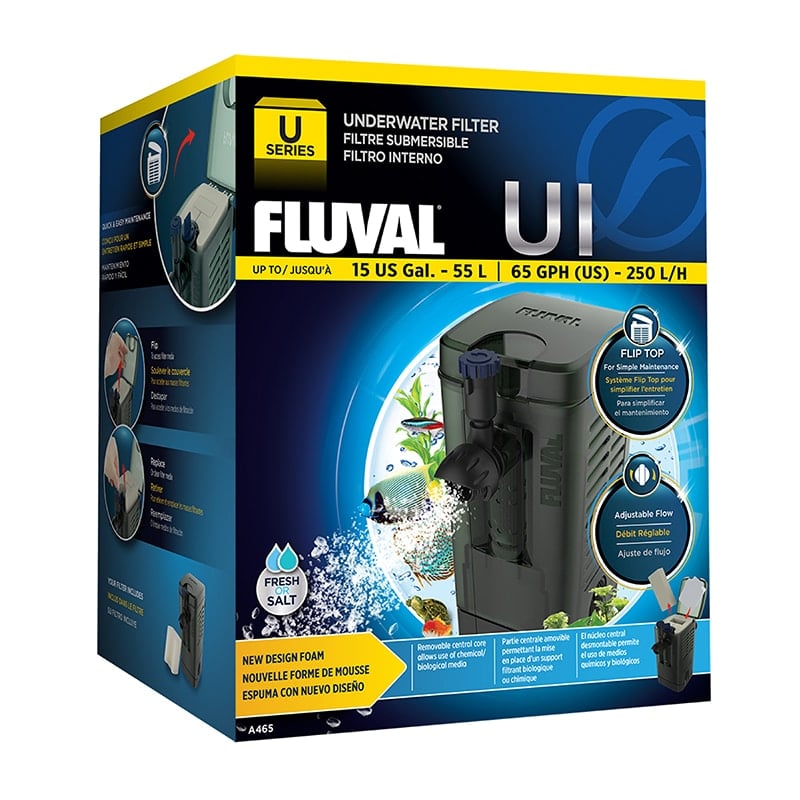
Explore this need in the finder →The U1 is the smallest current model in Fluval’s U Series of underwater filters. It is a distinct US product, not a size or bundle of the Nano filter: the manufacturer identifies the U1 as item A465, UPC 015561104654. The central question is whether an internal filter is a workable arrangement for the aquarium, not whether “15 gallons” alone settles the purchase.
Read the size label as a ceiling
Fluval’s current US item page states up to 15 US gallons / 55 L. The U-Series comparison also prints 14.5 US gallons / 55 L for the U1. Neither statement supplies a lower boundary, and the sources do not explain the slight gallon wording difference. I retain both printed claims rather than inventing a corrected conversion or a two-ended range. If you enter an exact aquarium volume into the finder, the U1 is not returned as a confirmed interval match because the lower end is unknown.
That strict result is intentional. A maximum aquarium label is not a fish-count limit, stocking recommendation, waste-load rating or assurance for an individual species. A crowded tank, a messy feeder or a sensitive habitat may need a different plan even when the nominal gallons are under the U1 ceiling. Check species-appropriate care guidance separately.
Small internal footprint, three outlet choices
Fluval lists a U1 body of about 4 × 3 × 6 inches, 65 US GPH pump output and 5 W at 120 V / 60 Hz. These are manufacturer specifications, not a measurement of water movement after the unit is mounted in a decorated aquarium. The reviewed table does not give a distinct filter-circulation rate. Avoid converting 65 GPH into a guaranteed tank turnover figure.
The U Series can be mounted vertically or horizontally, a useful option for a low-water or shallow layout, and its three-way outlet design provides a top output, integrated spray bar and bottom output. Those are selectable flow routes, not simultaneous benefits: choose the outlet that suits the surface movement and current pattern. Fluval says the venturi air valve operates only at the top outlet; bubbles are not expected from the spray bar or bottom outlet. “More bubbles” is not by itself a measure of filtration or oxygen saturation, so assess the tank’s actual setup and animal needs.
Check the included media carefully
The current US item page contains a BioMax-included statement and also lists a foam pad. The shared U-Series media chart says U1 includes the first mechanical stage only and lists one foam pad, with chemical and BioMax media described for the larger U2/U3/U4 models. Those official statements conflict. I would not treat a BioMax quantity—or even a uniform box configuration across current and older stock—as established without checking the exact A465 package. The discrepancy also makes an accessory bundle or a replacement-media listing easy to confuse with the filter itself.
Fluval describes the foam pad as capturing larger particles. The product page says the small unit is suitable as a primary filter for smaller aquariums or as a supplementary filter for larger ones, but that broad statement does not tell you how much maintenance a specific aquarium will require. The U-Series manual emphasizes regular media and impeller care, cleaning media in removed aquarium water rather than untreated tap water, and avoiding replacement of every biological surface at once. Follow the manual for the precise service sequence.
Where the U1 may be worth comparing
An internal unit avoids a gravity-fed canister beneath a stand, hoses running over the rim and cabinet clearance for a separate vessel. In exchange, the filter occupies aquarium space and must be reachable for removal and cleaning. Before choosing it, measure the interior around the intended wall: account for the body, bracket, substrate, plants, lid, nearby heater and the clearance needed to tilt or lift the filter out. A six-inch body may still be awkward in a very shallow or tightly arranged tank.
Compare U1 with the separate Nano filter rather than treating them as interchangeable. Both are small in-tank products with upper capacity claims, but their UPCs and media/output designs differ. The Nano page names two foam types and an attachable spray bar; U1 uses the U-Series output arrangement, and its included BioMax claim is unsettled. If you need a verified lower aquarium-volume boundary or exact media quantity, the current sources do not resolve that for U1.
Bottom line
The U1 is a compact internal option whose value depends on fit inside the tank, not simply on avoiding a cabinet. Its known strengths are the small listed body, low stated wattage relative to the larger U models, adjustable outlet options and a clear US model identity. Its important uncertainties are the lower volume boundary and conflicting included-media statements. This is a source-based assessment of manufacturer information; it does not report an installation, livestock trial, noise check or flow test. Confirm item A465, the package and instructions before buying, and treat the capacity label as only one input to a sound aquarium plan.
Primary references: Fluval U1 US product information, Fluval U-Series model comparison and U-Series manual.
Key specifications
Key details at a glance
| Published range upper bound | 15 US gal |
|---|---|
| Pump output | 65 US GPH |
| Power draw at 120 V / 60 Hz | 5 W |
| Manufacturer-supported water types | freshwater / saltwater / reptile_terrarium |
| US manufacturer item number | A465 |
| UPC | 015561104654 |
| Body length | 4 in |
| Body width | 3 in |
| Body height | 6 in |
| Manufacturer-listed outlet choices | Top outlet, integrated spray bar or bottom outlet (choose one setting). |
| Manufacturer-listed included media | 1 foam pad; individual item page also says BioMax included, while family chart says U1 includes stage 1 only |
| Manufacturer aquarium-size claim | up to 15 US Gal / 55 L; family table also prints 14.5 US Gal / 55 L |
Use the exact model’s instructions for operating limits, supplied equipment and version differences.
Sources for this review
Sources for this assessment
Start with your tank and installation constraints
Compare supported tank-volume intervals, external versus internal arrangements, installation space and media needs. An upper-only capacity claim cannot establish a complete volume fit, and the finder cannot infer your fish load.