
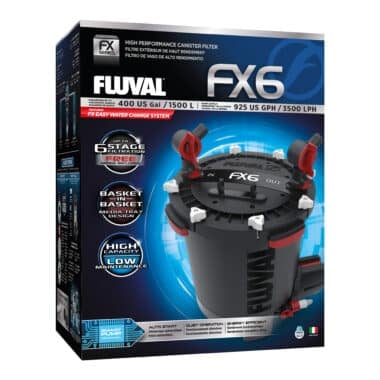
Your needs, this model
Does it fit your priorities?
How much media-basket space does the FX6 list?
Fluval lists 1.5 US gallons / 5.9 L of basket media across three main baskets. Its separate 5.28-gallon / 20-L filtration-volume value is not the same as usable basket volume.
Explore this need in the finder →Is the FX6 rated for 400 gallons of every livestock load?
No. Fluval states up to 400 US gallons, but the reviewed material does not provide a fish-count or high-waste rating. Aquarium volume and livestock demand must be considered separately.
Explore this need in the finder →Why does the FX6 need more cabinet planning than an FX4?
The FX6 body is listed at 20.8 inches tall versus 16.5 inches for the FX4, and it has an additional media basket. Allow room to remove the stack, reach the controls and direct the utility drain hose safely.
Explore this need in the finder →Does the utility valve remove routine filter maintenance?
No. It helps drain the canister, but Fluval's schedule still calls for cleaning and checking components, media and the canister. Keep the valve closed outside deliberate draining; the manual warns an open valve can spill water.
Explore this need in the finder →Evidence basis: this is a paper-based assessment of the Fluval US FX6 page, FX Series comparison, official manual and support material. It does not claim that the author has owned, installed or tested the filter.
The FX6 is the largest current FX canister, with a distinct service scale
The US FX6 is identified as item A219 and UPC 015561102193. Fluval lists it for aquariums up to 400 US gallons, the highest maximum in the FX2/FX4/FX6 family. That statement is not a lower-and-upper interval: the manufacturer does not publish a minimum tank size on the source page. It also does not define a fish-count or waste-load capacity. Use the 400-gallon value as a ceiling stated by the maker, not as a promise for every aquarium below it.
Compared with the FX4, the FX6 has a larger canister, an additional main media basket, 1.5 gallons (5.9 L) of stated media-basket volume rather than 1 gallon (3.9 L), and more listed mechanical surface area. It is taller, draws more power and has a higher circulation figure. Those differences can matter in a large system, but they also change cabinet requirements and the amount of water and media to handle at service. The FX2 is shorter in overall footprint and lacks the utility valve found on the FX4 and FX6.
Know what the three flow values do—and do not—say
Fluval lists the FX6 at 925 US GPH pump output and 563 GPH filter circulation. Its table distinguishes them, and the manual’s note says circulation was measured with equal-length inlet and outlet hoses and without media. These are not two measurements of the same in-tank condition. Neither tells us the actual flow after this filter is filled, connected through your plumbing, and used with your chosen media. This assessment does not turn the number into a calculated aquarium turnover promise.
The listed complete-canister volume is 5.28 US gallons (20 L), while the media baskets hold 1.5 gallons (5.9 L) of media. Fluval lists mechanical area at 325.5 square inches (2,100 cm²), a 10.8-foot (3.3 m) maximum head-pressure figure, 43 W at 120 V / 60 Hz, and dimensions of 15.75 × 15.75 × 20.8 inches. The body is about four inches taller than the FX4. Check the cabinet opening, floor load and room to lift the third basket stack, turn AquaStop valves and reach the utility hose before choosing by aquarium volume alone.
Three main baskets and a utility drain
The FX6 has three main baskets; the FX2 and FX4 have two. Fluval’s comparison lists six Bio-Foam inserts, two Bio-Foam+, two BioMax, one carbon foam pad and two media bags in the FX6 package. The US product page also lists media for mechanical, chemical and biological filtration. Confirm the actual A219 kit contents, especially if an offer is incomplete, used or bundled. Do not compare the 20 L canister value as though every litre were available for media; the basket volume is the relevant listed media-storage figure.
The utility valve and drain hose are useful differences from the FX2. Fluval describes draining the canister to reduce its weight and using the valve for aquarium water changes; its manual also supports a separately sold gravel-cleaner kit. The valve is not a substitute for inspecting seals, cleaning media or maintaining the impeller. The instructions emphasize leaving it closed when not in use because an open valve can spill water. When draining, the manual relies on gravity and warns that the level can equalize with the drain destination, so the outlet must be directed and managed carefully.
Installation conditions deserve a cabinet mock-up
The FX6 is a gravity-fed external filter, not an above-tank unit. Fluval says never to install it above the water level and recommends positioning the canister completely beneath the aquarium for best performance. The manual’s placement diagram and hose-length limits are model instructions, not optional tips: its supplied hose is 13.1 feet long, intake length is limited if additional hose is used, and the combined intake and outlet run has its own maximum. The hoses should follow a straight path without loops or slack. Before purchase, sketch the routes and check that the utility valve can be connected without moving the filter.
The smart-pump feature handles priming and periodic air evacuation, but it does not remove the need to set up the canister correctly. Fluval tells users to fill the vessel to the stated starting amount, secure the lid and AquaStop valves, close the utility drain and complete the installation before applying power. It will pause during the electronic priming sequence and briefly during periodic air removal. That is a documented operating behavior—not evidence of quietness in every room. The manual also includes safety instructions for electrical placement and a drip loop.
When its scale is useful, and when it is too much
The FX6 is worth evaluating when a large aquarium needs the maker’s largest current FX configuration and the stand has space for its 20.8-inch body, hose bends and service access. It is the family option with the most listed media-basket volume and the broadest mechanical area; the FX4 is smaller but retains the water-change valve, and the FX2 is more compact while giving up that valve. The best choice is not simply the biggest capacity label. A smaller filter may be easier to service or a better physical fit; an unusually demanding livestock plan may require evidence that Fluval does not publish here.
Before buying, verify the exact US A219 model, power edition, unmodified included parts, cabinet clearance, drainage access, and the manufacturer’s geometry for waterline and hose placement. Keep pump output separate from filter circulation, and assess stocking and flow needs independently. We have not performed a flow test, measured noise, or run the FX6 in a 400-gallon aquarium; the useful conclusion is what its documentation supports and what it leaves open.
Key specifications
Key details at a glance
| Published range upper bound | 400 US gal |
|---|---|
| Pump output | 925 US GPH |
| Filter circulation (maker stated) | 563 US GPH |
| Mechanical filtration area | 2100 cm² |
| Media-basket volume | 5.9 L |
| Main media baskets | 3 |
| Filtration volume (manufacturer label) | 20 L |
| Canister volume | 20 L |
| Maximum pump head pressure | 10.8 ft |
| Power draw at 120 V / 60 Hz | 43 W |
| Built-in drain valve | Yes |
| Manufacturer-supported water types | freshwater / saltwater |
| US manufacturer item number | A219 |
| UPC | 015561102193 |
| Body length | 15.75 in |
| Body width | 15.75 in |
| Body height | 20.8 in |
| Manufacturer-listed included media | Bio-Foam (6) / Bio-Foam+ (2) / BIOMAX (2) / Carbon Foam Pad (1) / Media Bags (2) |
| Manufacturer aquarium-size claim | up to 400 US Gal / 1500 L |
Use the exact model’s instructions for operating limits, supplied equipment and version differences.
Sources for this review
Sources for this assessment
Start with your tank and installation constraints
Compare supported tank-volume intervals, external versus internal arrangements, installation space and media needs. An upper-only capacity claim cannot establish a complete volume fit, and the finder cannot infer your fish load.