
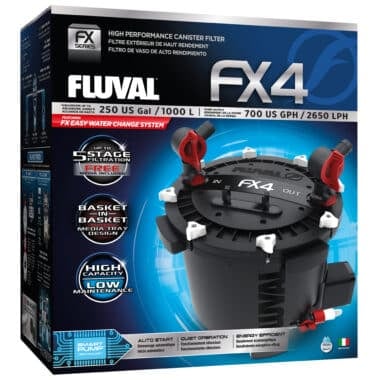
Your needs, this model
Does it fit your priorities?
Does the FX4 have a stated minimum aquarium size?
The US page gives a capacity of up to 250 US gallons but no lower bound. Treat the published value as a ceiling, not a complete fit interval or livestock-load promise.
Explore this need in the finder →What is the practical difference between the FX2 and FX4?
Both list 1 US gallon / 3.9 L of basket media, but the FX4 has a larger canister and mechanical area, higher listed flow figures, and the utility valve and supplied drain hose for draining and water changes. Those differences do not establish a stocking requirement.
Explore this need in the finder →Can the FX4 utility valve be left open between water changes?
No. The manual says the valve should remain closed when not in use and warns that an open valve causes an immediate spill. Direct the hose to a controlled sink, basin or drain and follow the instructions.
Explore this need in the finder →Do 700 GPH and 450 GPH mean the same thing?
No. Fluval labels 700 GPH as pump output and 450 GPH as filter circulation. The manual states its flow-rate setup conditions; they are manufacturer specifications, not an independent in-tank reading.
Explore this need in the finder →Evidence basis: this assessment uses Fluval’s US FX4 model listing, the US FX Series comparison, the FX Series manual and the manufacturer’s support answers. It is document-based analysis, not a personal installation, ownership account or independent test.
The middle FX is distinguished by more than its gallon label
Fluval identifies the FX4 as US item A214, UPC 015561102148, and states an aquarium capacity of up to 250 US gallons. That is an upper limit, not a published interval with a minimum. It is therefore less precise for volume-only matching than the two-ended ranges Fluval gives for its 07 filters. The FX4’s maximum does not establish that any particular livestock load will be appropriate, and its nominal gallon number is not a fish-count chart.
The FX4 sits between the FX2’s 175-gallon and FX6’s 400-gallon maximum ratings. It shares the FX2’s stated 1-gallon (3.9 L) media-basket volume and two main baskets, but has a larger canister, more mechanical area, higher pump and circulation figures, and a utility valve. The FX6 goes further in media storage and flow and is taller. This makes the FX4 a distinct middle configuration rather than a simple copy of the smallest model. Which differences matter depends on physical space, media plan and maintenance method.
Do not treat pump output as delivered tank flow
The manufacturer lists 700 US GPH as FX4 pump output and 450 GPH as filter circulation. Its comparison table says the circulation measurement uses intake and outlet hoses of equal length, and the manual’s table notes it is measured without media. Both are manufacturer figures, not an independent test of a filled filter connected to your tank. The pump output number should not be divided into aquarium gallons and presented as a guaranteed turnover rate.
Fluval lists 3.7 US gallons (14 L) for complete canister volume, while the media baskets hold 1 US gallon (3.9 L). These values describe different spaces. The comparison table also lists 217 square inches (1,400 cm²) of mechanical area, 30 W at 120 V / 60 Hz, a maximum head pressure of 6.9 feet (2.1 m), and a body size of 15.75 × 15.75 × 16.5 inches. The FX2 is narrower in footprint and shorter by no listed amount (both have a 16.5-inch body height), while the FX4 gains canister size and a utility drain system. Measure clearance for the body, hose turns, valve access and lifting the basket stack—not just the stand opening.
A water-change valve changes the service routine
The FX4 is the first of the current FX line with a multi-function utility valve and supplied drain hose. Fluval says it can discharge water from the canister, assist with aquarium water changes and connect to the separately sold FX gravel-cleaner kit. The manual instructs users to keep the valve closed when it is not being used; it warns that leaving it open causes immediate water spill. This feature may reduce the need to carry a full, heavy canister to a sink, but it adds a valve and hose that need correct positioning and use. It is not an automatic water-change controller, and the gravel-cleaner kit is not included merely because the filter has a valve.
The standard filter package includes hosing, rim connectors, intake and output parts, media baskets, filter media and the utility-valve hose. Fluval’s family table lists four Bio-Foam, one Bio-Foam+, two BioMax, one carbon foam pad and two media bags for the FX4. Verify those contents against the actual item A214 package before purchase, especially for a used unit or a listing that combines unrelated accessories. The media baskets are removable and stackable; the manual cautions against overfilling them and says granular media must be placed in a bag to protect the impeller chamber.
Placement, hose geometry and priming are non-negotiable
The FX4 is a gravity-fed external filter. Fluval’s manual says never to install it above the aquarium water level and recommends the canister sit entirely beneath the aquarium for best performance. It specifies a placement diagram, limits the supplied hose route, and says hose should run directly without slack or loops. The FX4 shares its listed 6.9-foot maximum head-pressure figure with the FX2, but that pump specification should not be mistaken for permission to mount the filter above the tank. Use the exact installation diagram to measure vertical placement and preserve the manual’s hose limits.
At startup the smart-pump sequence includes a short run, a pause for air evacuation and a restart; after that, the filter may pause briefly on a recurring schedule to purge trapped air. Finish filling and plumbing before plugging it in, keep the utility valve shut unless deliberately draining, and check the lid seal, fasteners and AquaStop connections. Routine service still involves wet foam, media, seals, hoses and an impeller, so “easy water change” does not mean no maintenance.
Where the FX4 makes the most sense
Consider the FX4 if you want a high-capacity external canister with the utility drain feature and enough cabinet room for a 16.5-inch-tall, broad-bodied unit. It is a plausible comparison point for a setup that would benefit from directed draining but does not need the FX6’s larger basket stack and 400-gallon ceiling. The FX2 is more compact but lacks the utility valve; the FX6 offers more media volume, greater listed circulation and a taller body. Fluval’s FX family also supports freshwater and saltwater use.
No reviewed manufacturer source assigns the FX4 a verified high-waste or stocking-density rating. Nor do published pump figures establish real flow in a particular aquarium. Before ordering, confirm item A214, power edition, package contents, cabinet and service clearance, below-waterline hose geometry, and a separate livestock plan. This review is based on specifications and instructions, not a filter tested in a tank.
Key specifications
Key details at a glance
| Published range upper bound | 250 US gal |
|---|---|
| Pump output | 700 US GPH |
| Filter circulation (maker stated) | 450 US GPH |
| Mechanical filtration area | 1400 cm² |
| Media-basket volume | 3.9 L |
| Main media baskets | 2 |
| Filtration volume (manufacturer label) | 14 L |
| Canister volume | 14 L |
| Maximum pump head pressure | 6.9 ft |
| Power draw at 120 V / 60 Hz | 30 W |
| Built-in drain valve | Yes |
| Manufacturer-supported water types | freshwater / saltwater |
| US manufacturer item number | A214 |
| UPC | 015561102148 |
| Body length | 15.75 in |
| Body width | 15.75 in |
| Body height | 16.5 in |
| Manufacturer-listed included media | Bio-Foam (4) / Bio-Foam+ (1) / BIOMAX (2) / Carbon Foam Pad (1) / Media Bags (2) |
| Manufacturer aquarium-size claim | up to 250 US Gal / 1000 L |
Use the exact model’s instructions for operating limits, supplied equipment and version differences.
Sources for this review
Sources for this assessment
Start with your tank and installation constraints
Compare supported tank-volume intervals, external versus internal arrangements, installation space and media needs. An upper-only capacity claim cannot establish a complete volume fit, and the finder cannot infer your fish load.