
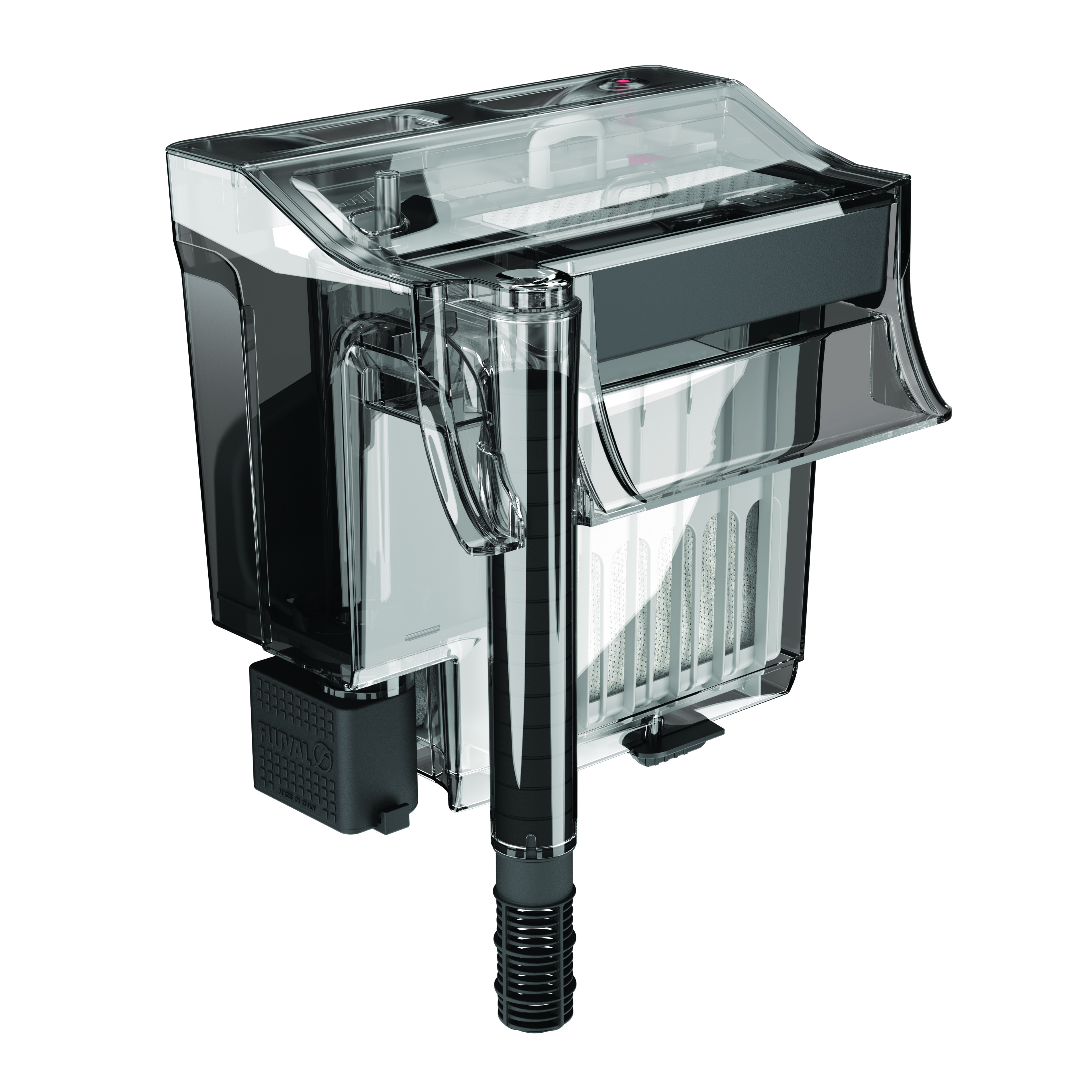
Your needs, this model
Does it fit your priorities?
Does Fluval document a 40–70 gallon range for the C4?
The current US product and family pages say up to 70 US gallons / 265 L but do not provide the lower endpoint 40 gallons. The C4’s upper limit therefore does not establish a complete 40–70 range in this evidence set.
Explore this need in the finder →Will C4 fit a rim that is thicker than the smaller C models allow?
Fluval gives the C4 a maximum rim thickness of 1 1/8 inches / 3.0 cm; C2 and C3 are limited to 1 inch / 2.5 cm. The C4 body is also larger at 8.3 × 6.1 × 8.5 inches, so check the rear wall, hood and basket-removal path.
Explore this need in the finder →What is C4’s listed maximum and adjustable flow range?
Fluval’s current US comparison lists 264 US GPH / 900 LPH filter circulation and 5 W at 120 V / 60 Hz. The North American manual describes an adjustable-flow arrangement, but its extracted value table does not retain clear voltage/value alignment for a normalized lower number; neither source is a measured aquarium turnover rate.
Explore this need in the finder →The Fluval C4 is the largest of the three current C-Series clip-on power filters listed in Fluval’s US catalogue. The manufacturer identifies the US item as 14003, UPC 015561140034, and gives it an “up to 70 US Gal / 265 L” aquarium-capacity ceiling. It is still a hang-on-back filter: its body sits on the rear rim rather than below the tank or fully inside it. This assessment is based on the current US product page, family comparison, North American instruction manual and parts listings; no hands-on testing or ownership is claimed.
Capacity, circulation and dimensions are separate claims
The C4’s “up to 70 gallons” wording is not a two-ended 40–70 gallon interval. The current US comparison gives an upper limit without a lower aquarium-volume endpoint. A hard exact-volume filter therefore cannot certify a match from this claim alone. Fluval lists 264 US GPH / 900 LPH as filter circulation at 120 V / 60 Hz, with 5 W power draw. Its North American manual confirms the adjustable-flow arrangement, but the extracted maximum/minimum table does not retain sufficiently clear voltage/value alignment to normalize the extra flow rows as paired US technical ratings. The current US comparison is the cleaner source for model-specific paired electrical figures; neither set is an independently measured aquarium result.
The listed C4 housing is 8.3 × 6.1 × 8.5 inches, notably larger than the C2/C3 body. That increases the space the user needs behind and above the aquarium, beyond the nominal width of the glass rim. The C4 may be a useful comparison for someone looking at the family’s highest stated capacity and larger housing, but that is not a recommendation for a 70-gallon tank or a substitute for assessing livestock, flow needs and maintenance.
Its rear-rim constraints differ from C2 and C3
Fluval states that the C4 fits an aquarium rim up to 1 1/8 inches / 3.0 cm thick, while the C2 and C3 are limited to 1 inch / 2.5 cm. Do not infer compatibility from the phrase “clip-on”: measure the actual rim, lid track, brace and rear-wall gap at the intended location. A thicker C4 housing also means checking whether the hood opens and whether the chemical basket and mechanical frame can be lifted without contacting a wall or light fixture.
The North American manual says the tank’s minimum water level should be no more than 2.25 inches / 6 cm below the rim, and requires the filter to be level. Initial operation is not simply plug-and-play: install the leveling device, fill the filter case completely, place the intake U-tube control at minimum, allow priming, and then adjust the flow. The manual states that reducing output can send some water through the chamber more than once, with up to 50% reprocessed in the filter chamber. That describes the internal refiltration design; it does not mean that 50% of aquarium volume is additionally filtered or that any species will tolerate the return flow.
What the C4 offers for media and service
The family design has two mechanical, one chemical and two biological filtration stages. Fluval lists poly/foam, activated carbon, BIOMAX and Bio-Screen pad among the included media, and describes a wet/dry trickle chamber using C-Nodes for the biological stages. A pop-up indicator is intended to rise when the poly/foam pad needs rinsing or replacement; the mechanical foam slides out, while a draw tab aids removal of the chemical basket. This is a deliberately serviceable media arrangement, but the official material reviewed does not specify a C4 basket volume in litres. Do not translate the C4’s larger overall dimensions into a numerical media-capacity claim.
The manual recommends regular media cleaning every two weeks for maximum operation and efficiency, alternates insert changes to help preserve biological activity, and calls for periodic motor/impeller cleaning. Those instructions make a maintenance route important: provide room above the filter to remove trays and a safe way to disconnect and service it. A larger clip-on housing is still attached to the aquarium and does not have the separate cabinet isolation of a canister. If the aquarium has sensitive species, a low waterline, a narrow hood opening or an awkward wall position, those practical constraints may outweigh the larger capacity label.
How C4 compares with the smaller family models
At the current listed maximums, the C2 is up to 30 gallons with 119 GPH and a 6-inch body length; C3 is up to 50 gallons with 153 GPH and a 7-inch length; C4 is up to 70 gallons with 264 GPH and an 8.3-inch length. C4 is also taller and wider, and its allowable rim thickness is slightly greater. All three are listed at 5 W for the US configuration and use the same five-stage approach. These differences can help choose which exact model to inspect, but the family’s upper-only capacity labels do not create lower bounds, and a larger model does not establish a high-bioload match.
Before selecting the C4, verify the exact item 14003, measure the rim and waterline gap, confirm enough rear and overhead space for service, and make a plan for checking and rinsing media. Current Fluval materials do not document a lower tank-volume limit, an exact litre media-basket figure or model-specific high-waste suitability. If any of those facts is essential, the C4 cannot be confirmed on the evidence here. Consult its current US product page, C-Series comparison table and North American manual, then confirm the precise package before treating accessory or media listings as included equipment.
Key specifications
Key details at a glance
| Published range upper bound | 70 US gal |
|---|---|
| Filter circulation (maker stated) | 264 US GPH |
| Power draw at 120 V / 60 Hz | 5 W |
| Manufacturer-supported water types | freshwater / saltwater |
| US manufacturer item number | 14003 |
| UPC | 015561140034 |
| Body length | 8.3 in |
| Body width | 6.1 in |
| Body height | 8.5 in |
| Manufacturer-listed included media | Poly/Foam pad / activated carbon / BIOMAX / Bio-Screen pad / C-Nodes in the biological trickle chamber |
| Adjustable flow control | Yes |
Use the exact model’s instructions for operating limits, supplied equipment and version differences.
Sources for this review
Sources for this assessment
Start with your tank and installation constraints
Compare supported tank-volume intervals, external versus internal arrangements, installation space and media needs. An upper-only capacity claim cannot establish a complete volume fit, and the finder cannot infer your fish load.