
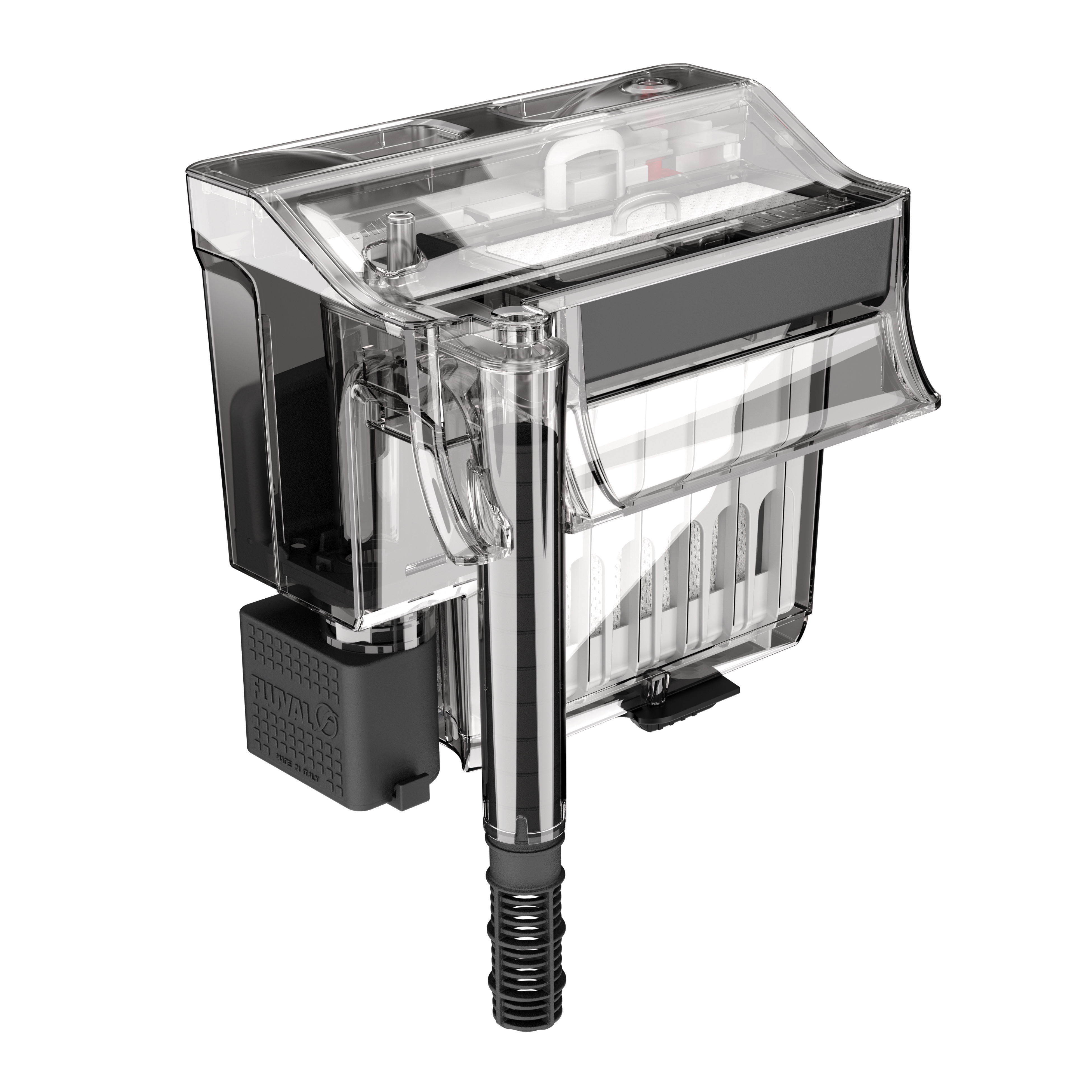
Your needs, this model
Does it fit your priorities?
Does the C3's 50-gallon label describe a full operating interval?
No lower endpoint appears in the current US C3 page or family comparison reviewed here. Fluval lists the model up to 50 US gallons / 190 L; this review does not infer a smaller-volume limit or suitability from the ceiling alone.
Explore this need in the finder →What installation limits distinguish C3 from C4?
Fluval allows up to a one-inch rim for C3 and says the maintained waterline must remain no more than 2.25 inches below the rim. C4 accepts a 1 1/8-inch rim but has a larger 8.3 × 6.1 × 8.5-inch body; the C3 is 7 × 4.7 × 6.7 inches.
Explore this need in the finder →What does Fluval publish for C3 flow and power?
The current US comparison lists 153 US GPH / 580 LPH filter circulation and 5 W at 120 V / 60 Hz. The North American manual describes an adjustable-flow table, but its extracted voltage/value alignment does not support a reliable normalized lower-flow pair; use the current page for paired specifications.
Explore this need in the finder →The Fluval C3 is the middle-sized model in the current Fluval C-Series clip-on line. Fluval’s US material identifies the item as number 14002, UPC 015561140027, and lists it for aquariums up to 50 US gallons. This is a powered hang-on-back filter whose housing sits outside the tank while its intake and return interface with the aquarium. The following review is a source-based assessment of the current US model, not a report of personal ownership or testing.
Read “up to 50 gallons” as a ceiling
The current C-Series comparison gives the C3 a one-sided “up to 50 US Gal / 190 L” claim. It does not publish a lower endpoint for this model on the US family page, so the number is not a verified 20–50 gallon interval. The filter may physically run on a smaller aquarium, but that is different from the maker documenting a complete interval. In this finder, a hard numerical tank-volume answer requires both limits; the C3 therefore cannot satisfy an entered exact-volume request from the ceiling alone.
Fluval lists 153 US GPH / 580 LPH as C3 filter circulation at 120 V / 60 Hz and 5 W. These are manufacturer values, not an in-tank measurement under a specific media load, head height or stocking pattern. The North American manual separately describes an adjustable-flow system and includes maximum/minimum values in a table, but the extracted layout does not preserve its voltage/value pairings clearly enough to normalize its LPH entries alongside the current US table. This assessment uses the clearly paired current US specifications and relies on the manual’s unambiguous startup and adjustment steps rather than inventing a precise lower operating flow from a poorly aligned extract.
Measure the rim and operating waterline
The C3’s body is listed at 7 × 4.7 × 6.7 inches, a one-inch increase in length over the C2 while retaining the same listed width and height. Fluval gives the C2 and C3 a maximum aquarium rim thickness of 1 inch / 2.5 cm. That is a real compatibility screen: measure the glass plus any rim or brace where the filter would sit, and check that the hood can still close. The North American manual further requires the tank waterline to remain no more than 2.25 inches / 6 cm below the aquarium rim. If you run a low water level, or the lid design forces a larger gap, the C3’s correct operation and priming cannot be assumed.
The manual asks that the filter be level on the back of the aquarium and uses its leveling device to correct the position. For first startup, the user fills the filter body, starts the intake-tube adjustment at minimum, lets the filter prime, and then sets the desired flow. This is a useful distinction from a fixed-output cartridge design: the C3 has a control lever and Fluval’s refiltration path can recirculate some water within the filter chamber when flow is slowed. Fluval says this can lengthen media contact time and create gentler return flow, but the statement is not a guarantee of a particular turnover rate or a substitute for considering tank circulation and species needs.
Five-stage layout and upkeep implications
Fluval describes five stages in the C-Series: two mechanical, one chemical and two biological. The listed included media are poly/foam, activated carbon, BIOMAX and Bio-Screen pad; the C-Nodes sit in the wet/dry biological trickle chamber. The product description says all media is included, and the draw tab helps remove the chemical basket while the mechanical foam slides out for rinsing. A cleaning indicator rises when the poly/foam pad needs rinsing or replacement. These features make separate service access visible in the design, but they do not provide a published C3 media-basket capacity in litres. If a specific litre minimum or extensive custom-media layout is critical, verify package drawings or the actual unit before buying rather than treating the 7-inch body as an internal basket measurement.
Fluval’s manual recommends regular media cleaning every two weeks for maximum operation and efficiency, alternating insert changes to maintain biological activity, and periodically cleaning the impeller and motor. The interval is a maker recommendation, not evidence that it is sufficient for every stocked aquarium. Service access is therefore part of “fit”: leave space to lift the lid, pull the mechanical frame and access the motor safely. When maintaining a mature tank, avoid replacing all established biological media at once simply because a calendar or indicator calls for a change; follow the manufacturer’s instructions and aquarium-care advice appropriate to the system.
Compare the adjacent C sizes without treating them as intervals
Within this family, C3 is listed between the C2’s 30-gallon ceiling and the C4’s 70-gallon ceiling. Its 153-GPH circulation label is between 119 and 264 GPH, and its housing is larger than the C2’s but smaller than the C4’s. C2 and C3 share the 1-inch rim limit, while C4’s is slightly larger at 1 1/8 inches. All three share the five-stage concept and 5-W US listing, but the larger label does not establish a better biological match or prove that a C3 is appropriate for a particular 50-gallon livestock load. If the aquarium’s upper nominal size exceeds 50 gallons, the C3’s maker label is not a fit confirmation; if it is smaller, the missing lower value remains unknown.
Before choosing the C3, confirm the US item 14002, measure rim thickness and waterline gap, plan a level rear-wall position, and check that media removal will be practical with the tank’s hood. Fluval does not publish a lower aquarium-volume endpoint, a comparable litre basket size or an explicit high-waste rating for this model in the reviewed material. Those unknowns matter if a hard requirement depends on them. Read the C3 item page with the family comparison and North American manual; check an exact retail package because a title or accessory listing alone does not establish what is in a bundle.
Key specifications
Key details at a glance
| Published range upper bound | 50 US gal |
|---|---|
| Filter circulation (maker stated) | 153 US GPH |
| Power draw at 120 V / 60 Hz | 5 W |
| Manufacturer-supported water types | freshwater / saltwater |
| US manufacturer item number | 14002 |
| UPC | 015561140027 |
| Body length | 7 in |
| Body width | 4.7 in |
| Body height | 6.7 in |
| Manufacturer-listed included media | Poly/Foam pad / activated carbon / BIOMAX / Bio-Screen pad / C-Nodes in the biological trickle chamber |
| Adjustable flow control | Yes |
Use the exact model’s instructions for operating limits, supplied equipment and version differences.
Sources for this review
Sources for this assessment
Start with your tank and installation constraints
Compare supported tank-volume intervals, external versus internal arrangements, installation space and media needs. An upper-only capacity claim cannot establish a complete volume fit, and the finder cannot infer your fish load.