
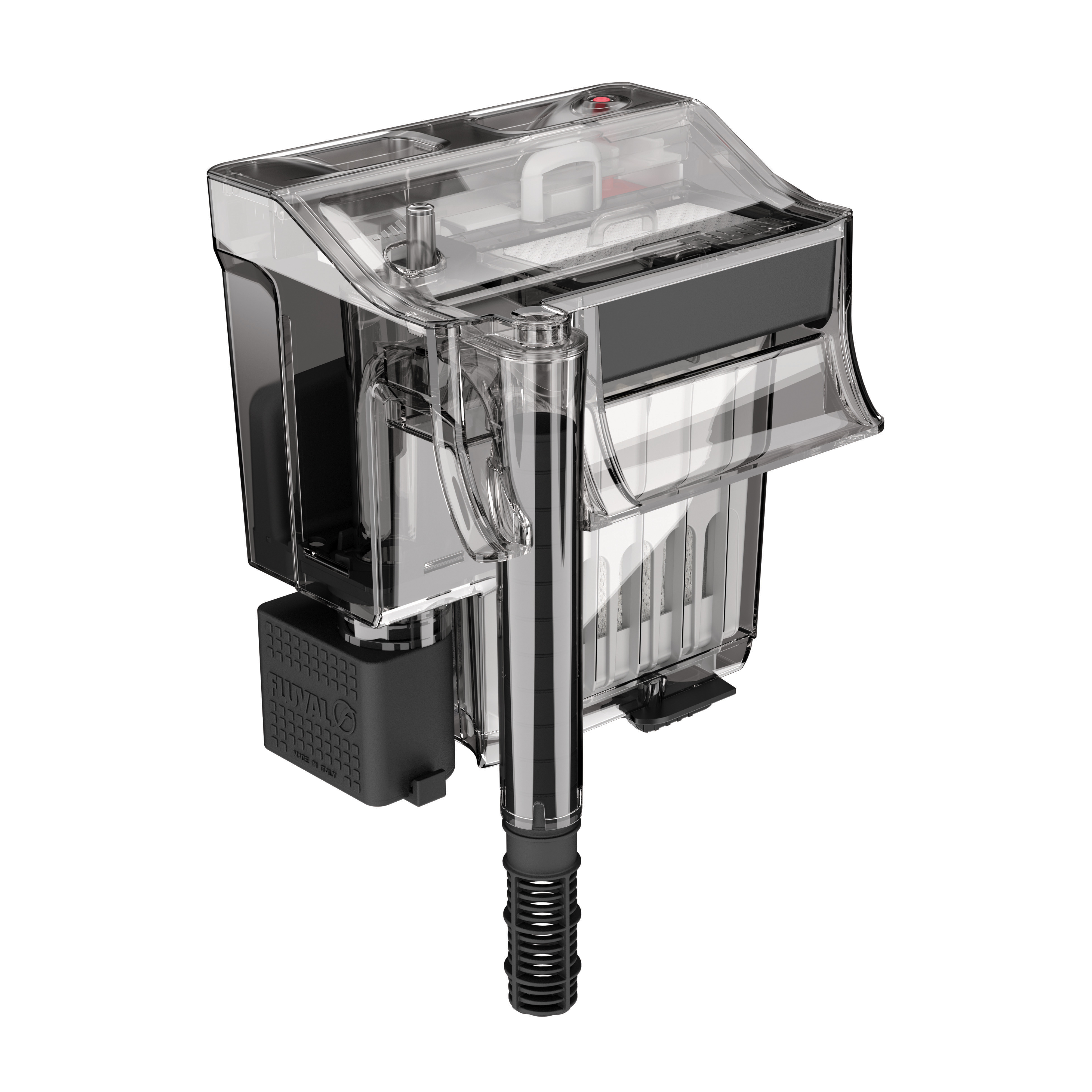
Your needs, this model
Does it fit your priorities?
Does Fluval give the C2 a complete aquarium-volume range?
The current US page labels the C2 for aquariums up to 30 US gallons / 115 L, but the reviewed source set does not supply a lower endpoint. The label is a ceiling, not a complete interval or a livestock-load guarantee.
Explore this need in the finder →What rim and waterline conditions should I check for C2?
Fluval lists a one-inch maximum rim for C2 and says the tank waterline should be no more than 2.25 inches below the rim. The unit also needs to sit level; verify the hood and service access at the exact mounting position.
Explore this need in the finder →How does the C2 differ from C3?
The current comparison lists C2 up to 30 US gallons, 119 US GPH circulation and a 6 × 4.7 × 6.7-inch body; C3 is up to 50 gallons, 153 GPH and 7 × 4.7 × 6.7 inches. Both share the one-inch rim limit, five-stage design and 5-W US listing.
Explore this need in the finder →The Fluval C2 is the smallest of the three current C-Series clip-on power filters found in Fluval’s US catalogue. Its current US item number is 14001 and the product page identifies it as a freshwater-and-saltwater filter for aquariums up to 30 US gallons. It is a hang-on-back device, not an internal unit and not an external canister. This assessment is based on the manufacturer’s current US product and family pages, its North American C-Series manual and the US filtration archive; it is not a hands-on test.
What the C2’s volume and flow labels establish
Fluval’s current US page gives an “up to 30 US Gal / 115 L” capacity label. It does not state a lower tank-volume endpoint on the family comparison, so this guide does not convert that ceiling into a complete 5–30 or 10–30 gallon interval. A smaller aquarium may be physically compatible, but this source set does not document a lower volume boundary or a stocking plan. The filter’s 119 US GPH / 450 LPH figure is labelled filter circulation at 120 V / 60 Hz, not an independent measurement in a populated aquarium. The same comparison lists 5 W and a 6 × 4.7 × 6.7-inch body. Use those as model-specific comparison values, not as a prediction of water quality or noise in a particular setup.
There is a source-format limitation worth keeping visible. The current US family page supplies clearly paired figures for both electrical listings: 119 GPH / 450 LPH at 120 V / 60 Hz and 106 GPH / 400 LPH at 230–240 V / 50 Hz. The North American manual has a separate adjustable-flow table with maximum and minimum rows, but the extracted table layout does not preserve its voltage/value pairings clearly enough to normalize every litre-per-hour entry. This assessment uses the current US comparison for the paired model figures and the manual for its clear installation and maintenance instructions, rather than forcing the ambiguous table into a second set of voltage-specific values.
Fit the rim, water level and filter body before choosing it
The C2 hangs from the rear aquarium wall. Fluval states that C2 and C3 fit rims up to 1 inch / 2.5 cm thick; the C2 should therefore be checked against the actual glass, brace, hood and lid rather than the tank’s nominal size. The manual also says the tank’s water level should be no more than 2.25 inches / 6 cm below the rim for correct operation and priming. That is an operating constraint, not a decorative dimension. Measure the waterline you will maintain, especially if the tank is covered or loses water between top-offs.
The manual calls for the filter to sit level and describes using the supplied leveling device after mounting. For startup, Fluval directs the user to fill the filter case completely, set the intake-tube flow control to its minimum position, plug it in, allow it to prime, and then adjust the control. The C-Series design slows return flow while increasing time in the filter; Fluval says up to 50% of water in the filter chamber may be processed more than once when flow is reduced. That statement is about the manufacturer’s refiltration arrangement, not a claim that half the whole aquarium is filtered repeatedly or that it can replace appropriate circulation elsewhere.
Media stages and the service routine
The C-Series uses five filtration stages: two mechanical stages, one chemical stage and two biological stages. The maker lists a poly/foam pad, activated carbon, BIOMAX and Bio-Screen pad as included media; its product description explains that the wet/dry trickle chamber and C-Nodes belong to the biological side of the design. Fluval describes the media as included, but does not give a C2 basket volume in litres. If a minimum litre capacity is essential, the available record cannot verify that requirement. Do not infer it from the model number, the case dimensions, or the count of inserts.
The manual makes maintenance part of the installation plan: it suggests regular media cleaning every two weeks for maximum operation and efficiency, calls for alternating insert changes to preserve continuous biological activity, and recommends periodic impeller/motor cleaning. Those are manufacturer instructions, not a promise that every aquarium will need exactly the same schedule. A rising pop-up indicator is meant to signal when the poly/foam pad needs attention; it does not monitor ammonia, nitrate or biological capacity. Make room above and behind the unit to remove the mechanical frame and chemical basket without striking the lid or disturbing the tank.
Where it sits among the C-Series choices
The C2 shares the family’s clip-on arrangement, five-stage architecture, flow adjustment and 5-watt listing with the larger C3 and C4. Its distinction is the smaller published ceiling and body: 30 gallons, 119 GPH and a 6-inch body length. C3 is listed up to 50 gallons at 153 GPH, while C4 is listed up to 70 gallons at 264 GPH and uses a larger 8.3-inch-long housing. The C2 and C3 share the 1-inch rim limit, whereas C4 allows 1 1/8 inches; none of those capacity labels resolves the flow preferences of particular fish or plants. The C2 may be worth comparing when an available rear-rim installation and a compact listed body matter, but the tank must still meet the stated upper limit, waterline and rim conditions.
Before selecting a C2, check the exact US item 14001 rather than a bundled kit or replacement part, inspect the tank’s rim and lid, confirm that the maintained waterline is within the manual’s limit, and decide whether the supplied media and two-week inspection cadence suit your routine. The evidence does not give a lower supported tank-size endpoint, a comparable litre basket capacity or a high-waste stocking rating. Treat those as unanswered questions, not as evidence of failure or proof of a suitable fit. The current C2 product page, C-Series comparison and North American manual are the controlling references for exact model, limits and care steps.
Key specifications
Key details at a glance
| Published range upper bound | 30 US gal |
|---|---|
| Filter circulation (maker stated) | 119 US GPH |
| Power draw at 120 V / 60 Hz | 5 W |
| Manufacturer-supported water types | freshwater / saltwater |
| US manufacturer item number | 14001 |
| UPC | 015561140010 |
| Body length | 6 in |
| Body width | 4.7 in |
| Body height | 6.7 in |
| Manufacturer-listed included media | Poly/Foam pad / activated carbon / BIOMAX / Bio-Screen pad / C-Nodes in the biological trickle chamber |
| Adjustable flow control | Yes |
Use the exact model’s instructions for operating limits, supplied equipment and version differences.
Sources for this review
Sources for this assessment
Start with your tank and installation constraints
Compare supported tank-volume intervals, external versus internal arrangements, installation space and media needs. An upper-only capacity claim cannot establish a complete volume fit, and the finder cannot infer your fish load.