
Your needs, this model
Does it fit your priorities?
Is a 55-gallon aquarium inside AC70's maker range?
Yes, 55 US gallons lies inside Fluval's 40–70 US gallon interval. The family comparison's range is not an endorsement of any particular stock density or species combination.
Explore this need in the finder →How much rear space does the AC70 need?
Fluval's US FAQ calls for at least four inches between the aquarium and wall for AC70. It also lists a 0.9-inch maximum rim and says the waterline should be no more than 1.5 inches below the filter output. Check all three constraints together.
Explore this need in the finder →Does AC70 use more wattage than AC50?
The maker's comparison table lists 7 W at 120 V / 60 Hz and 5 W at 230–240 V / 50 Hz for both AC50 and AC70. Their size ranges, maximum flow, body dimensions and rear-wall clearances differ despite those matching listed wattages.
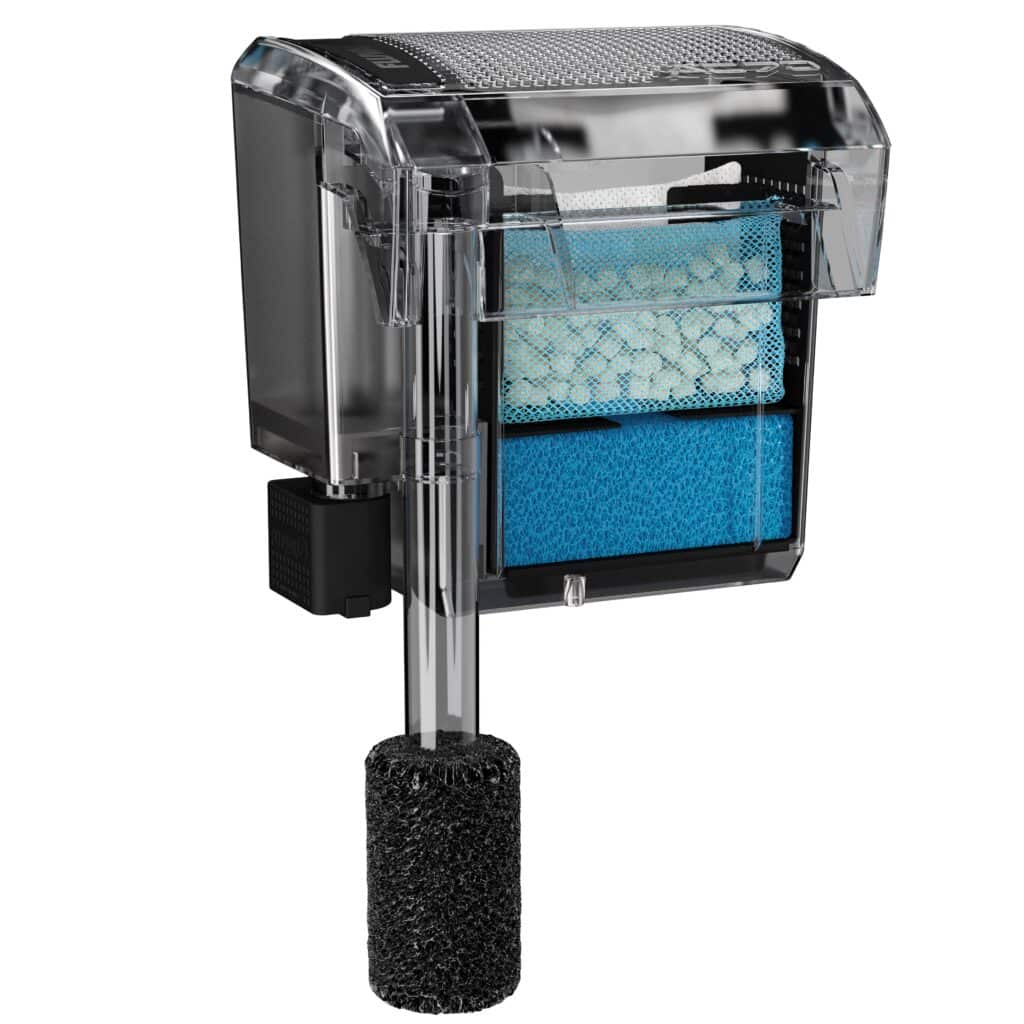
Explore this need in the finder →Fluval’s current AC70 Power Filter is item 19615 / UPC 015561196154. The US AC Series comparison lists 40–70 US gallons / 152–265 L, 300 US GPH maximum flow, 7 W at 120 V / 60 Hz and 5 W at 230–240 V / 50 Hz. Its 8.5 × 6.1 × 8.6-inch body is noticeably larger than the AC20, AC30 and AC50 housings. The amount of space behind the aquarium is a key part of its fit, not a detail to leave until after purchase.
Where AC70 sits in the line
AC70’s printed 40–70 US gallon range overlaps AC50 from 40 to 50 gallons and AC110 from 60 to 70. A 60-gallon aquarium is inside both AC70 and AC110’s manufacturer intervals, so the numbers do not choose between them. Fluval lists AC110 at 500 US GPH maximum flow, a 13.6 × 6.9 × 9.2-inch body and a different wall, rim and media profile. It is not enough to pick the higher maximum just because two ranges overlap.
AC70’s 300 US GPH is a maker-listed maximum flow rate. The reviewed comparison does not give this model a separate filter-circulation measurement. No measurement here predicts the actual current at your aquarium’s return or after the media has been used. Fluval describes an adjustable lever and a refiltration route that can process up to half of the water multiple times in the chamber at minimum flow. That design statement is not an individualized flow curve or evidence of suitability for delicate species.
Media and maintenance
Fluval describes AC filtration as four stages: two mechanical functions, chemical media and biological media. The current AC-Series media table lists one intake sponge, one Bio-Foam, one carbon insert and one BIOMAX insert for AC70. The table lists two carbon and two BIOMAX inserts only for AC110. That package difference is a concrete distinction; it does not establish that AC110 can safely support twice as many fish or twice the waste.
CycleGuard is presented as support for changing one of the three main media inserts at a time. Keep the filter's parts and job separate in a maintenance plan: the intake sponge is a prefilter, foam catches material, the BIOMAX insert is biological media and carbon is chemical media. Fluval’s FAQ recommends rinsing the intake sponge monthly and replacing it after two months, with more frequent attention potentially necessary depending on the aquarium. Follow the exact model’s instructions and account for access around the basket and impeller.
The maker does not give AC70 a media-basket litre value in the comparison table. Do not infer basket capacity from the 8.6-inch height or treat “four stages” as a quantified media volume. If a minimum basket size is essential, this is an unknown rather than a match.
The installation clearances are larger than the small models
The AC Series FAQ gives AC70 a minimum four-inch gap between aquarium and wall. It permits rim thickness up to 0.9 inch—the same maximum the FAQ gives AC20, AC30 and AC50—and says water should be no more than 1.5 inches below the bottom of the output. The smaller three models instead have a 5/8-inch water-level limit. That extra allowable gap does not remove the wall or rim limits; check them together with lid, light, power cord and nearby equipment.
AC70 is still a hang-on model, not a canister under the tank. It can avoid cabinet space, but the body occupies an external position behind the aquarium and the intake extends into the water. Make sure there is room to mount it, fill and service it, and that the aquarium edge can carry the model as instructed. Its higher body also changes clearance compared with AC20/30/50. Fluval’s product-page claim about a stepped filter-to-tank interface being self-leveling in most cases applies to AC70, but it is not an assurance of compatibility with every rim geometry.
Flow, sound and capacity claims
The manufacturer attributes a re-engineered precision rotor and quieter operation to AC20/30/50/70, and describes a sound-dampening cover. Those are maker descriptions, not results from an acoustic or durability test. The published page gives no sound level and no independent flow result. If quiet operation is a must, consider the claims but verify how the exact setup behaves and maintain the impeller as directed.
Tank volume is likewise only one screen. Fluval provides the 40–70 gallon range but no verified AC70 high-bioload or species-load rating in the sources reviewed here. Stock size, feeding, waste and care frequency still need their own consideration. A larger filter can have more maximum flow and a larger body without guaranteeing the desired current pattern or a particular animal outcome.
Bottom line
AC70’s clearest strengths in the source record are its defined range, adjustable-flow clip-on design, four listed media components and precise install limits. The main tradeoffs are its large body and four-inch wall clearance; its range also overlaps neighboring AC models. Confirm the current 19615 / UPC 015561196154 configuration, measure the wall and rim before ordering, and consult husbandry guidance independently. The regional Canadian item page corroborates the same model identity, while current US family-table data supplies the US specifications. This review does not claim a tank trial, ownership, noise test, measured flow or stocking result.
Primary references: Fluval AC Series US comparison, Fluval AC70 item identity cross-check, AC20/30/50/70 manual and Fluval AC Series FAQ.
Key specifications
Key details at a glance
| Published range lower bound | 40 US gal |
|---|---|
| Published range upper bound | 70 US gal |
| Power draw at 120 V / 60 Hz | 7 W |
| Manufacturer-supported water types | freshwater / saltwater |
| US manufacturer item number | 19615 |
| UPC | 015561196154 |
| Body length | 8.5 in |
| Body width | 6.1 in |
| Body height | 8.6 in |
| Manufacturer-listed included media | pre-filter intake sponge / Bio-Foam / activated carbon / BIOMAX |
| Maximum listed flow rate | 300 US GPH |
| Maximum listed flow rate (paired maker value) | 1136 LPH |
| Minimum rear-wall clearance | 4 in |
| Maximum aquarium rim thickness | 0.9 in |
| Maximum waterline gap below outlet | 1.5 in |
| Adjustable flow control | Yes |
Use the exact model’s instructions for operating limits, supplied equipment and version differences.
Sources for this review
Sources for this assessment
Start with your tank and installation constraints
Compare supported tank-volume intervals, external versus internal arrangements, installation space and media needs. An upper-only capacity claim cannot establish a complete volume fit, and the finder cannot infer your fish load.