
Your needs, this model
Does it fit your priorities?
What size range does the US AC30 carry?
Fluval's current US AC30 page and comparison table state 10–30 US gallons / 38–114 L. The separate paired litre label is quoted as printed; this assessment does not silently convert it or treat it as a stock rating.
Explore this need in the finder →Is the AC30 shorter than the AC50?
The manufacturer table lists AC30 as 6.1 × 4.4 × 6.4 inches and AC50 as 7.2 × 4.4 × 6.4 inches. Measure the available rim position and service access for the exact model; width alone is not a fit check.
Explore this need in the finder →Can the AC30 be used without cabinet space under the tank?
It hangs on the aquarium rim, so it does not require a below-tank canister location. It does require the manual's wall clearance and compatible rim thickness, plus water maintained near the outlet height.
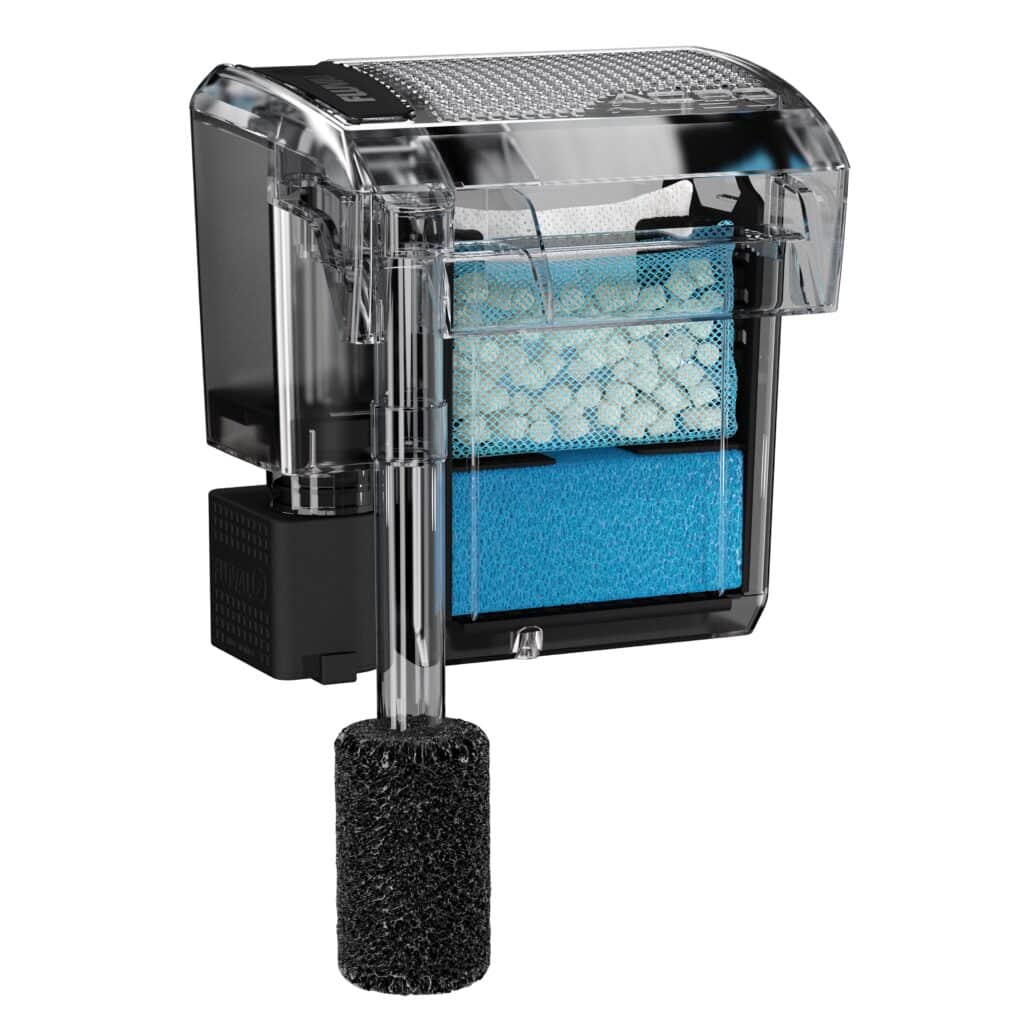
Explore this need in the finder →Fluval’s current US AC30 Power Filter is item 19600 / UPC 015561196000. It is the middle member of the current AC Series family, not the older AquaClear 30 whose item number is A600F. The AC30’s published aquarium interval is 10–30 US gallons / 38–114 L; the comparison table lists 150 US GPH maximum flow and a 6.1 × 4.4 × 6.4-inch housing. Its case is longer than the AC20 but shares the smaller models’ stated height and depth.
A middle size with overlapping neighbours
The name “30” can sound like a direct match for a 30-gallon aquarium, but the full range is the more useful reading: ten through thirty US gallons. AC20 covers 5–20 gallons, while AC50 covers 20–50. AC30 overlaps AC20 across 10–20 and AC50 from 20–30, so there is no volume-only point where AC30 is the single hang-on option in this current family. At 25 gallons, for instance, the AC30 and AC50 both sit inside their printed intervals. That is a reason to compare body clearance, media plan and setup—not to assume the higher maximum-flow number is always needed.
Fluval lists AC30’s 150 US GPH as a maximum flow rate. Its comparison table does not report a separate circulation figure for this model. The rating is not an independent measurement through the installed unit, nor does it establish turnover once the media collects debris or a flow setting is changed. A volume range and maximum flow are useful published specifications, but neither substitutes for a separate livestock and maintenance plan.
Four stated stages, several separate media jobs
The AC Series is described as a four-stage filtration path with two mechanical functions, chemical media and biological media. For AC30, the maker’s standard-box chart lists one intake sponge, one Bio-Foam, one carbon insert and one BIOMAX insert. This is a more precise package statement than the broad phrase “all media included”; if comparing used equipment or retailer bundles, verify that the exact model and listed inserts are present.
Fluval’s CycleGuard description focuses on changing one of the three main media inserts independently rather than replacing all at once. The intake sponge is a separate prefilter component. The company also describes an adjustable-flow, patented refiltration path that can circulate up to half of the water through the filter chamber more than once when set to minimum. These are design descriptions; they do not quantify how much beneficial bacteria an aquarium will maintain or how its water will test.
One useful practical question is whether the pump and media will be easy to reach for cleaning. Fluval’s FAQ says reduced flow can be associated with dirty media or an impeller assembly that needs cleaning. It recommends monthly rinsing of the intake sponge and replacement every two months, with more frequent attention sometimes needed for a particular aquarium. Follow the exact manual’s procedures and avoid treating a general schedule as a guarantee for a stocked tank.
AC30’s rim and waterline requirements
Like the rest of the AC line, AC30 is a hang-on filter rather than an internal unit or a below-tank canister. Fluval gives AC20/30/50 a 0.9-inch maximum rim thickness and asks for at least 2.75 inches of space between aquarium and wall. For AC30, the water level should be no more than 5/8 inch below the bottom of the return output. Measure with the aquarium’s lid, brace, lamp, cords and adjacent equipment in place. A tight wall position or thick frame can matter more than a nominally suitable gallon rating.
The 6.1-inch length is a little greater than AC20’s 5.1 inches and less than AC50’s 7.2 inches; all three list 4.4 inches of width and 6.4 inches of height. AC30 is listed at 7 W on 120 V / 60 Hz and 5 W on 230–240 V / 50 Hz, the same figures as AC20, AC50 and AC70. AC70, however, is a larger housing and needs a wider wall gap. Check the intended position and the room needed to lift out the basket before assuming the AC30 fits.
What the line’s shared claims do—and do not—say
Fluval describes a re-engineered rotor and stepped filter-to-tank interface for AC20/30/50/70, with the stepped design intended to self-level in most cases. The manufacturer also says the AC-series covers and revised materials are intended to reduce noise. These remain maker claims rather than measurements from this review. The published page does not give a sound level, individual flow curve, media-basket litre value or stocking class for AC30.
The package includes mechanical, chemical and biological media, but no specific basket capacity is presented. So there is no evidence-based way here to compare AC30 with another model by litres of basket space or assign a minimum media-volume score. If basket volume is an essential selection rule, this record remains unknown rather than treating the entire outer case as media space.
Bottom line
AC30’s strengths on paper are a defined 10–30 US gallon interval, a common but adjustable AC-series media arrangement, a middle-sized body and current US model identification. Its limitations are the same factors that need a careful setup check: the volume range overlaps adjacent sizes, no high-bioload rating is documented, and the fit still depends on rim thickness, wall clearance and waterline. Confirm current AC30 item 19600 rather than older A600F stock and check the specific box. This assessment is based on manufacturer sources; no ownership, aquarium installation, performance, noise or animal trial is claimed.
Primary references: Fluval AC30 US product page, AC Series US comparison, AC20/30/50/70 manual and Fluval AC Series FAQ.
Key specifications
Key details at a glance
| Published range lower bound | 10 US gal |
|---|---|
| Published range upper bound | 30 US gal |
| Power draw at 120 V / 60 Hz | 7 W |
| Manufacturer-supported water types | freshwater / saltwater |
| US manufacturer item number | 19600 |
| UPC | 015561196000 |
| Body length | 6.1 in |
| Body width | 4.4 in |
| Body height | 6.4 in |
| Manufacturer-listed included media | pre-filter intake sponge / Bio-Foam / activated carbon / BIOMAX |
| Maximum listed flow rate | 150 US GPH |
| Maximum listed flow rate (paired maker value) | 568 LPH |
| Minimum rear-wall clearance | 2.75 in |
| Maximum aquarium rim thickness | 0.9 in |
| Maximum waterline gap below outlet | 0.62 in |
| Adjustable flow control | Yes |
Use the exact model’s instructions for operating limits, supplied equipment and version differences.
Sources for this review
Sources for this assessment
Start with your tank and installation constraints
Compare supported tank-volume intervals, external versus internal arrangements, installation space and media needs. An upper-only capacity claim cannot establish a complete volume fit, and the finder cannot infer your fish load.