
Your needs, this model
Does it fit your priorities?
Is AC20 within its published tank-size interval for a 5-gallon aquarium?
Yes, 5 gallons is the lower endpoint of Fluval's 5–20 US gallon interval. That is only a size-label match; it does not establish the right filter for a particular species, stock level or water-flow preference.
Explore this need in the finder →How much space must I check behind an AC20?
The manufacturer FAQ calls for at least 2.75 inches from the aquarium to the wall, and its manual group sets a 0.9-inch maximum rim and water within 5/8 inch of the output. Measure the assembled setup rather than assuming that every lid or brace clears.
Explore this need in the finder →Does the AC20's maximum flow rate tell me how much flow my stocked tank will receive?
No. Fluval lists 100 US GPH as maximum flow, not as an independent measurement through your installed filter and media. Its adjustable-flow/refiltration description is not a livestock-load or turnover guarantee.
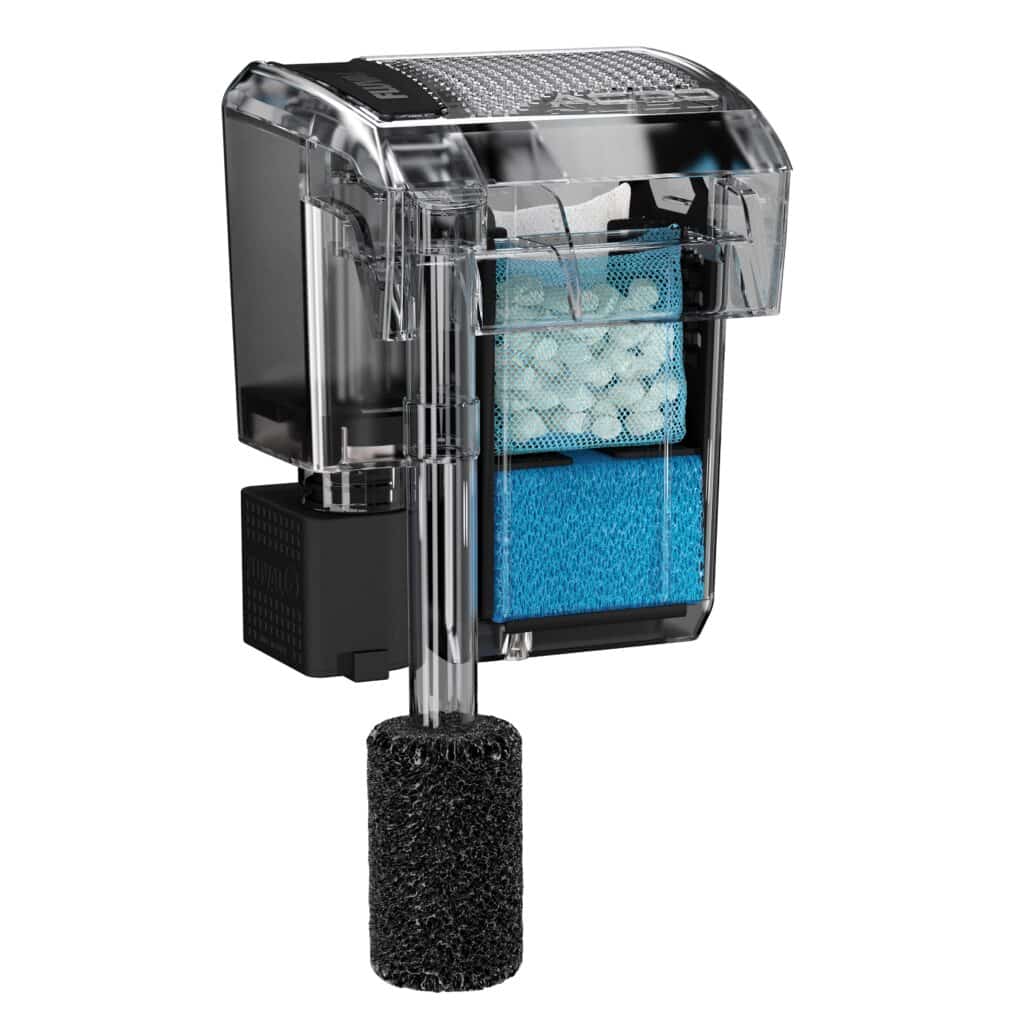
Explore this need in the finder →The AC20 is the smallest of Fluval’s current AC Series clip-on filters. It is a distinct current US model, item 19595 / UPC 015561195959—not the older AquaClear 20 SKU A595F. The manufacturer’s US table rates AC20 for 5–20 US gallons, lists maximum flow of 100 US GPH and gives a compact 5.1 × 4.4 × 6.4-inch body. Those facts make it a plausible candidate for a small aquarium, but the tank label alone cannot settle the filtration plan.
Keep the 5–20 gallon label in perspective
Fluval prints “5–20 US Gal / 18–76 L.” That is a manufacturer aquarium-size interval, not an independent test, a fish-count limit or an endorsement of every possible community or high-waste arrangement in that volume. A lightly stocked five-gallon planted tank and an aquarium with messy feeders ask different things of their filtration even if both fall inside the same numeric interval. AC20’s page and family materials do not provide a model-specific high-bioload rating, so an essential request for that evidence should not be treated as met.
The 100 US GPH figure is labelled maximum flow rate in the manufacturer’s comparison table. It is not a measured flow through a particular setup, and Fluval does not give a separate filter-circulation measurement for AC20 in that table. The adjustable lever changes the flow path; the family page describes a refiltration feature that can process up to 50 percent of the water multiple times in the chamber when flow is reduced. That is a maker description, not a promise of a specific turnover rate in your tank.
What sits in the filter
Fluval describes four filtration stages: two mechanical functions plus chemical and biological media. Its included-media chart lists one intake sponge, one Bio-Foam, one carbon insert and one BIOMAX insert for AC20. The prefilter sponge catches some material before it reaches the pump; the foam and porous biological medium have separate roles, while the carbon is chemical media. Fluval’s CycleGuard design is described around changing one of the three main inserts at a time rather than replacing all of them together. Treat that as a maintenance approach, not proof of a specific bacterial capacity.
Flow can be adjusted, which matters when the return current is too forceful for the aquarium’s layout or inhabitants. It does not make the filter a species-specific flow controller: observe the setup and consult appropriate care guidance. The AC family also supports an add-on surface skimmer sold separately, but that accessory does not turn a surface film into a bioload measurement or substitute for correct water care.
Measure the rim and wall before looking at the box
AC20 hangs from the aquarium rim, so it avoids a below-tank canister position but creates its own geometry checks. Fluval’s FAQ gives a maximum aquarium rim thickness of 0.9 inch for AC20, AC30, AC50 and AC70. For the smaller three models, it asks that the aquarium sit at least 2.75 inches from the wall. The water level should be no more than 5/8 inch below the bottom of the filter output. A lid, rim brace, light, plumbing or narrow stand clearance can defeat an otherwise suitable gallon-range match.
In daily care, plan to reach the media basket, intake and impeller without moving the aquarium or bending hoses. The official FAQ recommends rinsing the intake-strainer sponge monthly and replacing it every two months, with more frequent rinsing possibly needed for a particular aquarium. Fluval identifies dirty media or impeller debris as possible causes of reduced flow and motor noise. These are maintenance prompts, not a prediction of how often an individual tank will need service.
How it differs from the next sizes
AC20’s 5–20 range overlaps AC30’s 10–30 range from 10 through 20 gallons, and it touches the AC50 interval at 20. The family table lists AC30 at 150 US GPH and 6.1 × 4.4 × 6.4 inches; AC50 is 200 US GPH and 7.2 × 4.4 × 6.4 inches. AC20 is therefore the shortest body in that group and has the lowest stated maximum flow, but those comparisons do not establish that AC20 or a larger neighbour is right for a given livestock plan. If your volume is at the edge of the stated interval, verify the exact model, installation constraints and species-specific care needs rather than selecting by number alone.
The manufacturer describes a re-engineered rotor and stepped filter-to-tank interface for AC20/30/50/70. Fluval says the interface can self-level in most cases; that is not a guarantee that a tank rim will fit without checking. The family comparison does not extend those specific claims to AC110, so they should not be generalized to every AC model.
Bottom line
AC20 has a clear identity, a small published footprint, an adjustable-flow clip-on format and an included set of mechanical, chemical and biological media. Its practical fit depends on a compatible rim, near-wall clearance, waterline height, service access and the aquarium’s actual biological load. Fluval does not publish a basket volume or high-load validation for this model. Confirm that a listing is current AC20 item 19595 rather than the separate older AquaClear 20, and check the package and instructions. This is an evidence-led assessment of manufacturer information; it does not report personal ownership, installation, livestock use, noise testing or measured flow.
Primary references: Fluval AC20 US product page, AC Series US comparison, AC20/30/50/70 manual and Fluval AC Series FAQ.
Key specifications
Key details at a glance
| Published range lower bound | 5 US gal |
|---|---|
| Published range upper bound | 20 US gal |
| Power draw at 120 V / 60 Hz | 7 W |
| Manufacturer-supported water types | freshwater / saltwater |
| US manufacturer item number | 19595 |
| UPC | 015561195959 |
| Body length | 5.1 in |
| Body width | 4.4 in |
| Body height | 6.4 in |
| Manufacturer-listed included media | pre-filter intake sponge / Bio-Foam / activated carbon / BIOMAX |
| Maximum listed flow rate | 100 US GPH |
| Maximum listed flow rate (paired maker value) | 379 LPH |
| Minimum rear-wall clearance | 2.75 in |
| Maximum aquarium rim thickness | 0.9 in |
| Maximum waterline gap below outlet | 0.62 in |
| Adjustable flow control | Yes |
Use the exact model’s instructions for operating limits, supplied equipment and version differences.
Sources for this review
Sources for this assessment
Start with your tank and installation constraints
Compare supported tank-volume intervals, external versus internal arrangements, installation space and media needs. An upper-only capacity claim cannot establish a complete volume fit, and the finder cannot infer your fish load.