
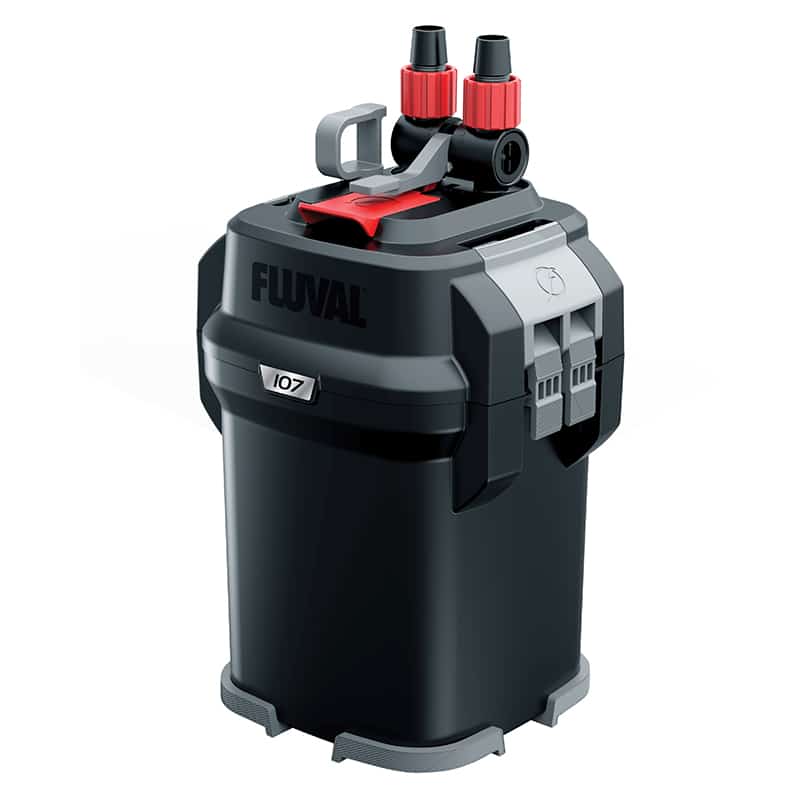
Your needs, this model
Does it fit your priorities?
Is the 107 within its stated range for a 15 US gallon aquarium?
Yes by nominal volume: Fluval lists this configuration for 10–30 US gallons. That is a size boundary, not a fish-load rating.
Explore this need in the finder →Can I place the 107 beside or above the aquarium?
No. The 07 manual describes a gravity-fed system and says the canister must always sit vertically below the aquarium; its base must stay within the stated 4.5 ft water-column limit and the hose route must be straight.
Explore this need in the finder →Does its tank-size label verify a fit for unusually high waste or stocking?
No such load rating was established in the reviewed manufacturer material. Resolve livestock load separately; do not use the 10–30 gallon label as a bioload guarantee.
Explore this need in the finder →How much media volume does the 107 provide?
Fluval lists a 1.2 L media-basket volume, separate from a 2.0 L total chamber and 3.9 L canister volume. The smaller basket is the family tradeoff to weigh against its size.
Explore this need in the finder →Evidence basis: this assessment compares Fluval's US product specifications, 07 Series manual and US support material. No aquarium-side measurements, use, ownership or comparative testing are claimed.
What the 107 is, and where it fits
The 107 is the smallest of the current Fluval 07 external canisters reviewed here. Fluval prints a recommended aquarium interval of 10–30 US gallons for this exact A440 configuration. That makes it a plausible candidate for a small-to-medium tank only when a canister under the aquarium, two hose runs over the rim and an accessible service location are all workable. It is not an in-tank device or a hang-on filter; if a stand has no protected space below the tank, this style is a poor match regardless of gallon count.
Capacity labels should be read narrowly. Fluval does not say that every stocking level, species, feeding routine or waste load inside 10–30 gallons receives the same filtration margin. The published range helps screen by water volume; it cannot substitute for a livestock-specific filtration plan. That distinction matters particularly for messy or heavily stocked aquariums, where the brand's FAQ itself points to increasing fish size, additional fish and waste as reasons maintenance demand can rise.
Interpreting the flow and media figures
The manufacturer's table lists 145 US gallons per hour as pump output but 95 US gallons per hour as filter circulation. They are separate published figures, not two interchangeable ways of describing aquarium turnover. Fluval notes that its circulation figure was measured with intake and output hoses of equal length. It is still a manufacturer specification rather than an independent measurement in a particular aquarium. This assessment therefore does not convert either value into a tested number of tank turnovers per hour.
For media planning, the most useful size is the stated 1.2-litre media-basket volume. The 2.0-litre total chamber and 3.9-litre canister volumes describe different spaces and should not be advertised as extra media capacity. Fluval also lists a 514 cm² vertical pre-filter. Compared with the 207, that is the smaller pre-filter area and basket; the 107's advantage is a smaller 7.5 × 7 × 13.7-inch canister body and a lower 10-watt listed draw. Those are concrete differences, not evidence that one configuration automatically handles a particular bioload better.
The package listing names foam and chemical media, including Bio-Foam Max, Bio-Foam, a 70-gram carbon amount, Quick-Clear and Bio-Foam+. The manual says the included media is arranged in baskets to show the suggested basic stack order. Keep track of that sequence when first setting up the unit, and do not overfill the baskets; media volume and what a seller actually includes are worth checking against the exact A440 package.
Installation is the decisive fit check
Fluval's manual describes this as a gravity-fed system and says the filter must always sit vertically below the aquarium. The canister base must be no more than 4.5 feet below the maximum water level, the hose route should be straight without loops and the aquarium surface should remain within seven inches of the rim. The 4.75-foot published water-column limit is not permission to mount the canister above the waterline. Before choosing it, measure clear cabinet height, the distance from the proposed canister base to the tank's operating water level, hose path, outlet access and enough room to remove baskets for care.
Setup also has a sequence: the manual tells owners not to energize the pump until the canister is full and primed. It calls for the intake away from an air source and for the waterline connection points to remain submerged. That is ordinary manual-guided plumbing, not a plug-and-play desktop device. A cramped or kink-prone hose route can defeat the apparent simplicity of the compact housing.
Ownership and maintenance implications
The large center handle is intended to let the media baskets lift out together, while the vertical pre-filter can be accessed independently. These details make routine service more organized on paper, but they do not eliminate the need to maintain the impeller, seals, intake strainer, hoses and media. Fluval's schedule covers several recurring intervals, from regular impeller checks to periodic intake and seal care. The manual specifically warns against replacing all filter media at once, preserving continuity in the biological media routine. Keep the supplied schedule with the aquarium notes rather than relying on the red or gray controls as a maintenance reminder.
The AquaStop valve allows output adjustment; the manufacturer says the flow can be reduced by up to 50 percent. Treat that as a bounded control, not as a substitute for choosing the right size or investigating excess current. Flow needs vary with inhabitants and aquascape, and there is no measured current profile in the material reviewed here.
Bottom line
The 107 is the most compact starting point in this four-model 07 group: its 10–30 US gallon label, 1.2-litre basket and 10-watt figure are specific, checkable boundaries. It is a reasonable shortlist entry for someone whose tank volume fits that printed interval, who has the required under-tank location and who accepts periodic canister service. It should not be selected solely because a tank is called “small,” or rejected solely because the model below it has a bigger number. Check real water volume, livestock waste, free cabinet dimensions and the exact replacement-media plan before treating this external filter as a fit.
Key specifications
Key details at a glance
| Published range lower bound | 10 US gal |
|---|---|
| Published range upper bound | 30 US gal |
| Pump output | 145 US GPH |
| Filter circulation (maker stated) | 95 US GPH |
| Vertical pre-filter area | 514 cm² |
| Media-basket volume | 1.2 L |
| Total chamber volume | 2 L |
| Canister volume | 3.9 L |
| Maximum below-tank water column | 4.75 ft |
| Power draw at 120 V / 60 Hz | 10 W |
| Manufacturer-supported water types | freshwater / saltwater |
| US manufacturer item number | A440 |
| UPC | 015561104401 |
| Body length | 7.5 in |
| Body width | 7 in |
| Body height | 13.7 in |
| Manufacturer-listed included media | Bio-Foam Max / Bio-Foam / Carbon 70 g / Quick-Clear / Bio-Foam+ |
| Manufacturer aquarium-size claim | 40–130 L |
Use the exact model’s instructions for operating limits, supplied equipment and version differences.
Sources for this review
Sources for this assessment
Start with your tank and installation constraints
Compare supported tank-volume intervals, external versus internal arrangements, installation space and media needs. An upper-only capacity claim cannot establish a complete volume fit, and the finder cannot infer your fish load.