
Your needs, this model
Does it fit your priorities?
Does the AT10's up-to-10-gallon label confirm fit for a 10-gallon tank?
No exact numeric match is certified. The catalog supplies only an upper ceiling and no lower interval endpoint, so the strict numeric screen fails closed even at the printed maximum.
Explore this need in the finder →Does AT10 avoid the need for a below-tank canister space?
Yes. Its supported arrangement is a fully submerged internal unit; it still needs an appropriate location, clearance and service access inside the aquarium.
Explore this need in the finder →Which replacement cartridge does Aqueon specify for AT10?
One Small cartridge. The current refill page identifies SKU 100106974 as a Small 2 Pack and names AT10 as taking one cartridge; Aqueon recommends about monthly replacement or earlier if needed.
Explore this need in the finder →This is a source-based assessment, not a hands-on test. No ownership, measured flow, noise, filtration performance, or reliability is claimed. The 2026 catalog identifies a current-reference AT10 configuration; operational details below come from Aqueon’s shared 2015 family manual.
What the current catalog identifies
Aqueon’s 2026 US catalog lists the QuietFlow Internal Power Filter AT10 as item 100537259, UPC 015905001212. The table prints an “up to 10 US gallons” label and separates the filter’s 3 × 1.375 × 5.75-inch item dimensions from a 3.875 × 2.375 × 6.25-inch retail package. That distinction matters if you are planning clearance: the item dimensions describe the body, not the box, while the box measurements are not the space the installed unit occupies. The product is an internal filter, so it sits in the aquarium rather than in a cabinet below it.
The number 10 in AT10 is not evidence that this is a 10-gallon-only model. Nor does the up-to-10-gallon ceiling establish a lower interval. Aqueon’s catalog table supplies no minimum tank volume, and the numeric finder requires both endpoints before it treats an entered gallon value as a confirmed interval match. As a result, this assessment can compare the AT10 as an internal arrangement but cannot certify it for an exact volume—even at the printed 10-gallon ceiling. An equipment label is not a livestock or waste-load rating.
Submerged placement and flow controls
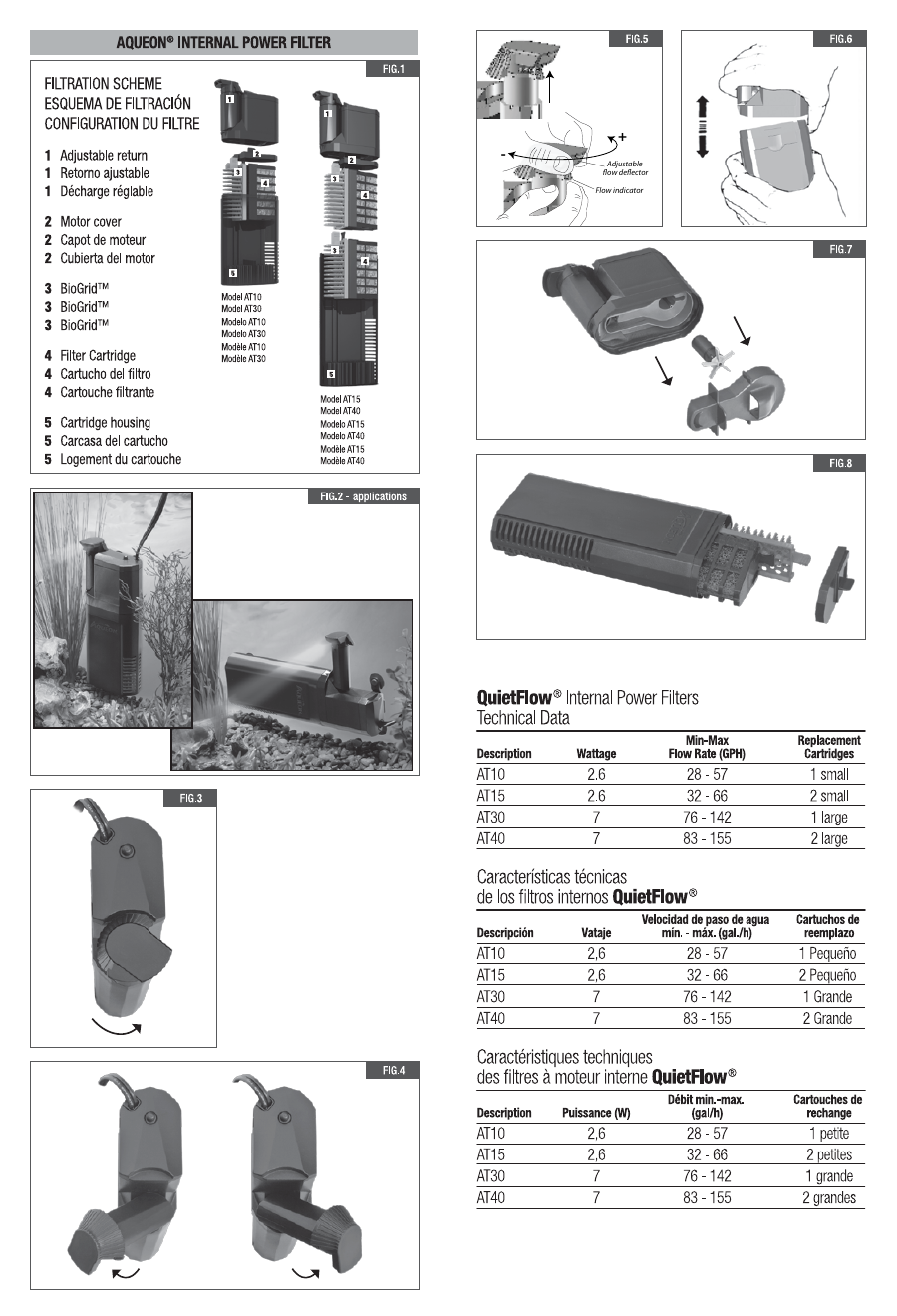
The shared QuietFlow Internal manual says the unit must be fully submerged and supports vertical or horizontal placement with suction cups. It also describes an adjustable flow control and a movable return/outlet. Those options give an installer more than one way to orient the unit and aim the return, but they do not make every position in every tank suitable. Leave room for the intake, avoid trapping the outlet against décor, and check that the body can be lifted out for service without disturbing the surrounding setup. Because the filter is inside the tank, its footprint and placement compete directly with aquascape and animal swimming room; this tradeoff remains even when a cabinet is not available.
Aqueon’s 2015 family-manual row for AT10 lists 28–57 GPH and 2.6 W. These are manufacturer figures from a family document, not a measurement of the unit in a particular aquarium. The listed GPH range should not be read as a guaranteed tank-turnover rate after media, water level, orientation, or maintenance are accounted for. The official evidence reviewed for this article does not state the AT10’s electrical input voltage or frequency, so verify the exact product label and instructions supplied with the purchased item instead of assuming an electrical rating from another model or a marketplace title.
Small cartridge, recurring maintenance
The catalog’s AT10 row specifies one Small replacement cartridge. Aqueon’s current replacement-cartridge family page identifies a Small 2 Pack as SKU 100106974 and says it is compatible with AT10; it also says to rinse and return a cartridge if flow slows before the usual replacement interval. The manufacturer’s instruction manual says to replace the cartridge about every 30 days or as needed. Those statements provide a usable starting point for planning replenishment, but the maker’s approximate schedule is not a measured service life for every aquarium. Follow the exact instructions that arrive with the filter and replacement pack.
The manual also advises preserving the BioGrid and rinsing it gently in aquarium water rather than tap water. That is a useful distinction between the replaceable cartridge and the biological material the maker intends to remain in service. Do not treat the whole cartridge as a substitute for the manual’s separate care guidance, and do not assume the 2026 catalog page establishes any unlisted included-media quantity beyond its stated one Small cartridge.
How it differs from the AT40—and what remains unknown
The AT10 is not simply the AT40 with a different label. The separate AT40 catalog row specifies a larger 10-inch item body, a larger package, two Large cartridges, and the family manual lists a higher 83–155 GPH range at 7 W. AT10 is the shorter 5.75-inch body with one Small cartridge and the 28–57 GPH, 2.6 W manual values. These are real documented configuration differences; they do not by themselves tell you which model is appropriate for a particular biological load. The catalog does not give a media-basket volume, and the reviewed sources do not provide a manufacturer high-waste rating for AT10.
The 2026 catalog page includes a general installed-filter illustration and a carton for the AT40, but no verified standalone photograph of the AT10 configuration. This review therefore does not use a neighboring size or a family picture as though it were an exact AT10 product image. The identity is supported by the catalog’s SKU and UPC row, not an image-derived claim.
Overall, AT10 is a compact in-tank option for a layout where an internal unit and adjustable outlet are desirable and where you can spare space inside the aquarium. Before choosing it, confirm SKU 100537259, measure the intended mounting area against the body dimensions, check the current electrical label and supplied contents, and plan for a Small cartridge. Do not interpret the upper-only gallon label, manual flow figure, or filter name as proof of numeric-volume or high-waste suitability.
Key specifications
Key details at a glance
| Published range upper bound | 10 US gal |
|---|---|
| US manufacturer item number | 100537259 |
| UPC | 015905001212 |
| Numeric finder evidence basis | The current 2026 US catalog gives an upper-only aquarium volume label; no lower endpoint is stated. The numeric finder requires both endpoints and therefore does not certify this exact volume claim for any entered tank size. |
Use the exact model’s instructions for operating limits, supplied equipment and version differences.
Sources for this review
Sources for this assessment
Start with your tank and installation constraints
Compare supported tank-volume intervals, external versus internal arrangements, installation space and media needs. An upper-only capacity claim cannot establish a complete volume fit, and the finder cannot infer your fish load.