
Your needs, this model
Does it fit your priorities?
Does Aquael's stated range include a 10-US-gallon aquarium?
Yes, 10 US gallons falls between the page's 10 L lower label (about 2.64 US gallons) and its 21.1 US-gallon upper label. Treat that interval as Aquael's starting aquarium-volume guidance, not a fish-load rating; the tank still needs space for an internal unit and its service removal.
Explore this need in the finder →What does the Bio version add over the standard Turbo Mini?
The Bio page lists a separate 100 ml BioCeraMAX 1600 compartment plus a chamber sponge and inlet prefilter. The standard Turbo Mini page describes a dense sponge and does not publish a comparable basket volume. Both pages list a 320 L/h maximum output and 4.4 W, so those shared labels do not erase the media and capacity-evidence differences.
Explore this need in the finder →Does 100 ml of ceramic media establish high-waste suitability?
No. Aquael lists a 0.1 L media container and a maximum output figure, but does not rate this configuration for high-waste stocking. The essential high-waste answer therefore has no documented match; do not turn a media volume or pump maximum into a husbandry recommendation.
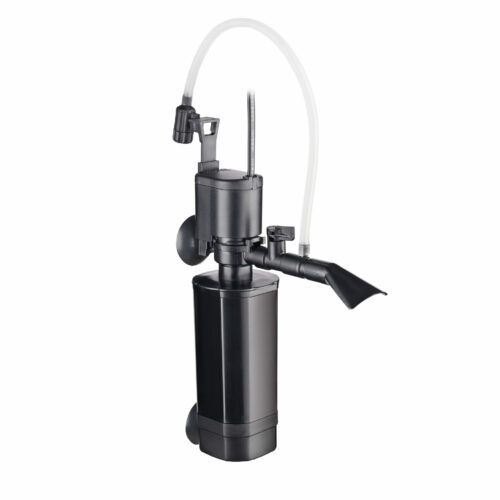
Explore this need in the finder →Aquael's current US-localized page identifies the Turbo Mini Bio as Art. nr. 135802. It is an internal freshwater filter built around a small pump, an inlet sponge prefilter and a second filter compartment. The page says the model is intended for aquariums from 10 to 80 liters, with an upper figure of 21.1 US gallons; the 10-liter lower point converts to about 2.64 US gallons. Those are Aquael's tank-size labels, not a stocking chart or an assurance that any particular livestock load is supported.
What the Bio configuration adds
The distinguishing feature is not its maximum flow number. Aquael describes a media container with a denser sponge and 100 ml of BioCeraMAX 1600 ceramic media, plus an inlet sponge that is easy to remove separately. The intended sequence is coarse debris at the inlet prefilter, finer mechanical filtration in the container, and a place for the ceramic media to support biological filtration. That extra chamber is the practical difference between Turbo Mini Bio and the standard Turbo Mini. Aquael's separate Turbo Mini page describes a dense sponge but does not publish an equivalent basket-volume figure.
For shoppers who compare a listed media minimum, the Bio page's 100 ml is 0.1 L. It is a small chamber: a 0.1-L threshold is met, but a 0.2-L minimum is not. This figure describes the maker's media container, not the total size of the housing or a calculated amount of biological capacity. It also does not tell us how much waste a given aquarium can safely process. The page's 320 L/h maximum and the presence of ceramic media are not substitutes for a high-waste rating, which Aquael does not provide for this model.
Capacity and flow need careful reading
Aquael gives the Bio a 10–80 L aquarium range and prints 21.1 US gallons for the upper size. On that evidence, a 10-gallon tank is within the maker's stated range, and an entered 21-gallon tank also falls below its upper label. The range remains only a first screening step: stocking, waste, water movement, tank shape and maintenance can all matter. The site page's dimensions heading combines inches and centimeters, but its visible row provides one triplet without a clear unit split. This assessment leaves body dimensions unquoted instead of presenting a possibly misread value as inches.
The motor is listed at 320 L/h, about 84.5 US GPH, and 4.4 W. Aquael also says the flow can be adjusted, the outlet directed, and an aeration tube used. These are useful choices in a small aquarium, where a strong jet may be awkward, but the maximum-output figure is not an installed-flow measurement. No minimum adjustable flow, tank-wide circulation rate or performance test is supplied here. The inlet sponge is described as reducing the chance that shrimp, fry or small fish are drawn in; that is a design feature, not a guarantee of safety for every animal or setup.
Placement, start-up and care
The motor and media compartment sit inside the aquarium, attached with suction cups and an adjustable hanger. The manual says to position the filter at least 3 cm below the waterline for its intended effect and to account for evaporation as the level falls; Aquael's US page cautions that the motor must stay submerged. This avoids a below-tank canister cabinet and hose route, but takes up space in the display and requires enough clearance to remove the prefilter or media compartment during service. Directing the outlet toward glass or the surface and dialing back the flow are the manufacturer-described ways to tune water movement.
Before the first start, Aquael's manual says to remove transport bags from the media and rinse the ceramic media to remove dust. For maintenance it separates the small inlet sponge from the biological bed: disconnect power before handling the unit, rinse the prefilter in aquarium-drained water when performance drops, and avoid disturbing the media more often than needed. The manual says to clean the impeller and its seat at least monthly, clean the ceramic media only as needed and no more often than once in two to four months, partially replace BioCeraMAX at six months, and replace the inner sponge at least every three months. These are the maker's instructions, not a schedule established by testing here; the exact supplied leaflet should govern the seller's version.
How it compares with nearby Aquael models
The standard Turbo Mini shares the 320 L/h and 4.4 W headline values but is described as a sponge-only unit, with no published media-container volume and an upper-only tank label. Turbo Mini Bio adds an inlet prefilter and a stated 0.1-L ceramic-media compartment, and its US page states a 10–80 L range. The larger Turbo Filter 500 is a different internal configuration: Aquael lists a 250 ml loose-media container and a less-than-30-gallon ceiling without a lower endpoint. They should not be collapsed into one review simply because all are internal filters with adjustable output.
Checks before considering an offer
Confirm that the listing names Turbo Mini Bio and item 135802; the category card's event identifier is 148971, which Aquael does not explain as a retail code. The exact product page and dedicated gallery use 135802, but neither the photo nor that mismatch confirms a seller's box revision. Ask the seller to verify the actual nameplate voltage and frequency, the included inlet sponge, inner sponge and BioCeraMAX media, and the instruction sheet for the package in hand. UPC, current electrical edition and exact retail bundle are not established by the reviewed page. Measure interior clearance, check that the motor will remain below the waterline, and plan how to service the media without confusing a manufacturer tank range with a livestock-load recommendation.
Source basis: Aquael US Turbo Mini Bio product page and its linked operating manual. Reviewed 2026-11-01; no hands-on testing or ownership is claimed.
Key specifications
Key details at a glance
| Published range lower bound | 2.64 US gal |
|---|---|
| Published range upper bound | 21.1 US gal |
| Media-basket volume | 0.1 L |
| Main media baskets | 1 |
| US manufacturer item number | 135802 |
| Manufacturer-listed included media | inlet sponge prefilter / denser sponge cartridge in the media container / 100 ml BioCeraMAX 1600 ceramic media as stated on the US product page |
| Maximum listed flow rate | 84.5 US GPH |
| Maximum listed flow rate (paired maker value) | 320 LPH |
| Adjustable flow control | Yes |
Use the exact model’s instructions for operating limits, supplied equipment and version differences.
Sources for this review
Sources for this assessment
Start with your tank and installation constraints
Compare supported tank-volume intervals, external versus internal arrangements, installation space and media needs. An upper-only capacity claim cannot establish a complete volume fit, and the finder cannot infer your fish load.