
Your needs, this model
Does it fit your priorities?
Does the 1500 begin at the same 65-gallon edge where the 1000 ends?
Yes. The US table lists 65–90 gallons for the 1500 and 30–65 gallons for the 1000. Both exact printed intervals meet at 65; the labels do not select a winner or indicate stocking load.
Explore this need in the finder →Does the 1500 remain in its interval at 90 gallons?
Yes. Aquael's exact row reaches 90 gallons; the 2000 begins at the same printed edge. At 90.5, the 1500 is beyond its ceiling, while the 2000 is inside its own interval.
Explore this need in the finder →Is 0.625 L total filter volume or the basket value?
The family page describes a 625 ml container for loose media in the 1000, 1500 and 2000 kits. It does not report total body volume; the 0.625 L value is the listed media chamber used here, not a total-volume claim.
Explore this need in the finder →The Aquael TURBO FILTER 1500 is a current US-listed internal-filter size rated for 65–90 US gallons, paired on the manufacturer table with 250–350 L. Aquael identifies the exact row as item 115068 and lists a 4 × 4.8 × 12.8 in body, 22 W and a maximum output/“efficiency” figure of 400 US GPH (1500 L/h). The pound-for-pound comparison with neighboring sizes should begin with those exact rows, not the rounded product number: its printed range overlaps both the 1000 at 65 gallons and the 2000 at 90 gallons.
What comes with the standard size
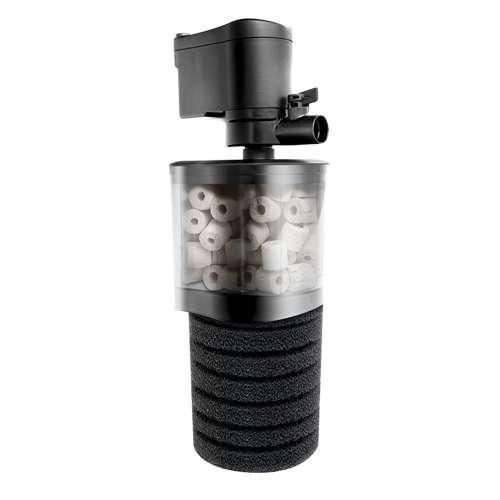
The TURBO 1500 is an internal filter, not an external canister. Its operating position is inside the aquarium, so it avoids a below-tank cabinet requirement but uses room within the tank and must remain accessible for media and impeller service. Aquael describes the family as combining sponge-based mechanical filtration, biological media, adjustable output and aeration. The current US family page says the 1000, 1500 and 2000 standard kits each have one loose-media container with 625 ml capacity, a starter filling of BioCeraMax Pro 600, a sponge and installation accessories. The page says more containers are available separately and can be connected in series; the standard configuration reviewed here does not assume any extra containers are included.
That 625 ml figure is a container capacity. It is not the whole unit’s internal volume, a measure of the sponge, or a high-waste certification. The 500 is different on this field: its page-listed container is 250 ml. The 1000 has the same 625 ml chamber as the 1500 but a lower output and a different range. When comparing media minimums, use the specific listed container value rather than the total size of the body or the amount of water in a tank.
The shared 65- and 90-gallon endpoints
The 1500 begins at 65 gallons, the same value at which the 1000 reaches its upper endpoint. It ends at 90 gallons, where the 2000 begins. The matcher therefore includes the exact endpoint for both adjacent size rows where the maker’s printed intervals meet. At 65.5 gallons, the 1000 is past its listed maximum but the 1500 remains in range; at 90.5, the 1500 is beyond its ceiling while the 2000 remains in its interval. This makes the range useful for distinguishing the actual model sizes without implying that 65 or 90 is a biologically exact threshold for all aquariums.
Aquael’s capacity labels do not state how many fish can be kept or how much waste can be handled. The 400 US GPH figure is a maximum manufacturer output, not our measurement of circulation after installation with media. No high-waste or stocking-density statement is documented for this model. Use the range as one piece of evidence and check the aquarium’s occupants, feeding, water movement needs and maintenance plan separately.
Body space and upkeep
At 12.8 in high and 4.8 in deep, the 1500 is larger in one dimension than the 1000, which the same table lists at 11.9 in high and 4.4 in deep. The 2000 shares the 1500’s listed dimensions, while the 1500 and 2000 differ in wattage and their range/output row. These dimensions are the filter body’s listed size, not a validated aquarium clearance envelope; provide access to detach and clean it, and verify your tank’s actual interior arrangement.
The linked shared manual describes the basic adjustments and service routine: use the voltage on the specific device, disconnect power before handling the filter, rinse the sponge in water drained from the aquarium, and clean the impeller chamber at least monthly. It recommends replacing about half of the BioCeraMax Pro 600 filling every six months. Follow the exact instructions shipped with your unit; this analysis is based on Aquael’s published sources rather than personal ownership or a controlled test. The current US page lists 22 W but no voltage or frequency for item 115068, so verify the electrical label and seller package.
Check the exact edition before buying
Aquael’s current US table assigns 115068 to the 1500. The linked family manual and size-specific gallery asset filename use 109404, and no item-number crosswalk is stated on the page. The image is associated by the current product page with the named 1500 size, but it is not an electrical-nameplate or package photograph. Confirm that an offer is the intended size and current model, check the voltage/frequency on the unit, and confirm the included sponge, container and starter media. If you need a particular media amount, stocking rating or flow result, ask for evidence of that exact claim rather than assuming it from 1500 in the product name.
Key specifications
Key details at a glance
| Published range lower bound | 65 US gal |
|---|---|
| Published range upper bound | 90 US gal |
| Media-basket volume | 0.62 L |
| Main media baskets | 1 |
| US manufacturer item number | 115068 |
| Body width | 4 in |
| Body height | 12.8 in |
| Manufacturer-listed included media | filter sponge / BioCeraMax Pro 600 starter biological media |
| Maximum listed flow rate | 400 US GPH |
| Maximum listed flow rate (paired maker value) | 1500 LPH |
| Adjustable flow control | Yes |
Use the exact model’s instructions for operating limits, supplied equipment and version differences.
Sources for this review
Sources for this assessment
Start with your tank and installation constraints
Compare supported tank-volume intervals, external versus internal arrangements, installation space and media needs. An upper-only capacity claim cannot establish a complete volume fit, and the finder cannot infer your fish load.