
Your needs, this model
Does it fit your priorities?
Does the maker-listed interval include 30 gallons?
Yes. The current US family table lists the TURBO FILTER 1000 at 30–65 US gal (paired with 150–250 L); 30 is its lower printed endpoint. It is a volume screen, not a bioload guarantee.
Explore this need in the finder →What changes at the 65-gallon edge?
At 65 gallons, the 1000 remains inside its printed interval and Aquael's 1500 also begins at 65. Compare the two actual sizes rather than reading the model number as a unique capacity recommendation.
Explore this need in the finder →Does the 1000 meet a 0.7 L minimum media-container request?
No. The manufacturer describes a 625 ml (0.625 L) loose-media container, which meets 0.6 L but not 0.7 L. It is not the total body volume or a high-waste validation.
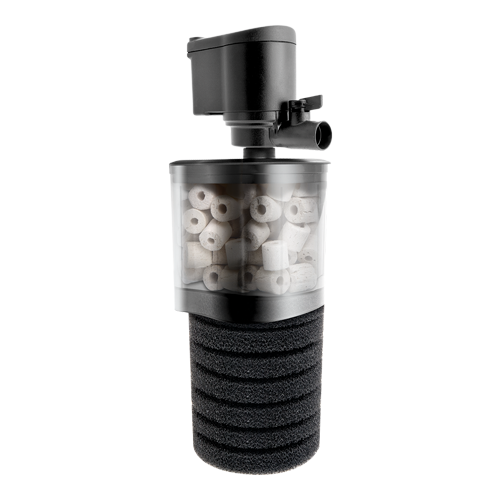
Explore this need in the finder →The Aquael TURBO FILTER 1000 is the second of four sizes in Aquael’s current US internal-filter table. The page lists item 115067, a 30–65 US-gallon range paired with 150–250 L, a 4 × 4.4 × 11.9 in body, 15 W and a maximum output/“efficiency” figure of 265 US GPH (1000 L/h). The paired gallon and litre labels are kept as Aquael prints them; they are not recalculated conversions. This is a manufacturer capacity screen, not a stocking or waste-load rating.
An internal format with a loose-media chamber
Unlike a canister, this filter operates inside the aquarium. It does not need a cabinet beneath the tank, but it claims some interior space and needs a place where the body can remain submerged and be accessed for service. Aquael describes the TURBO line as providing mechanical and biological filtration and aeration. The family page says the 1000 starter kit includes a sponge, a container for loose media and starter BioCeraMax Pro 600. It specifies 625 ml of loose-media capacity for the 1000, 1500 and 2000; the 500 instead has a 250 ml container. The 1000’s volume is a media container value, not the complete filter-body volume or the volume of its sponge.
Aquael also describes output adjustment, directional outlet adjustment and an aeration attachment. The filter is presented as compatible with other maker media options and with additional containers sold separately. Those additions can change the configuration; they are not included in this review’s standard one-container operating plan. If additional modules matter to your plan, confirm the exact accessory and installation instructions rather than counting a possible add-on as supplied equipment.
Why the 30- and 65-gallon edges matter
The 1000’s printed range starts at 30 and ends at 65 US gallons. Aquael’s table also pairs those edges with 150 and 250 L. At 30 gallons the 1000 enters the documented interval; at 65 gallons it reaches its upper edge while the 1500 begins its own listed interval. The shared 65-gallon endpoint is a real overlap between two different models, not a reason to treat their wattage, output or dimensions as interchangeable. A 65.5-gallon answer is beyond the 1000’s printed ceiling even though the next model may remain within its own range.
Those boundaries are useful for screening, but they do not translate directly into a fish count, feeding rate or measured tank turnover. Aquael labels 265 US GPH / 1000 L/h as its efficiency/output figure; this review does not present it as installed circulation, and no independent performance test was performed. The page does not state high-waste suitability. If the tank’s biological load is the central constraint, neither the gallon interval nor the flow label fills that evidence gap.
Size and maintenance in context
The 1000 is 11.9 in high in Aquael’s dimensions table. That height is a practical placement measurement, not a required clearance number; leave enough room to lift the unit and remove its media during service. The larger 1500 and 2000 are listed at 12.8 in high and 4.8 in deep, while the 1000 is 4.4 in deep. Compare the actual tank layout rather than assuming the model number only changes pump output. The 500 is lower in the size series and has a smaller 250 ml loose-media container, but its exact US capacity row is upper-only, so this matcher cannot certify a volume for it.
The shared manual says to use the voltage printed on the unit. It describes adjusting flow and aeration, unplugging before maintenance, rinsing the sponge with aquarium-changed water, and cleaning the impeller chamber at least monthly. It recommends replacing about half of the BioCeraMax Pro 600 filling every six months. Those are maker instructions; we did not own, install or test this filter. The current US row lists 15 W without stating the item-115067 supply voltage/frequency, so inspect the exact device label and instructions.
Version and package checks
The current US page names item 115067, while its linked family manual and model-specific gallery filenames use 109403. The page does not explain whether these article numbers cross-reference or identify a particular seller package. The photos are linked from Aquael’s exact TURBO family page and label the 1000 size, but they do not show an electrical label or prove what is in a current retail box. Confirm the exact item, box contents, supply rating, and any optional media-container parts with the seller. Do not assume a 625 ml chamber means a larger filter can handle a heavy bioload: the manufacturer provides no such rating here.
Key specifications
Key details at a glance
| Published range lower bound | 30 US gal |
|---|---|
| Published range upper bound | 65 US gal |
| Media-basket volume | 0.62 L |
| Main media baskets | 1 |
| US manufacturer item number | 115067 |
| Body width | 4 in |
| Body height | 11.9 in |
| Manufacturer-listed included media | filter sponge / BioCeraMax Pro 600 starter biological media |
| Maximum listed flow rate | 265 US GPH |
| Maximum listed flow rate (paired maker value) | 1000 LPH |
| Adjustable flow control | Yes |
Use the exact model’s instructions for operating limits, supplied equipment and version differences.
Sources for this review
Sources for this assessment
Start with your tank and installation constraints
Compare supported tank-volume intervals, external versus internal arrangements, installation space and media needs. An upper-only capacity claim cannot establish a complete volume fit, and the finder cannot infer your fish load.