
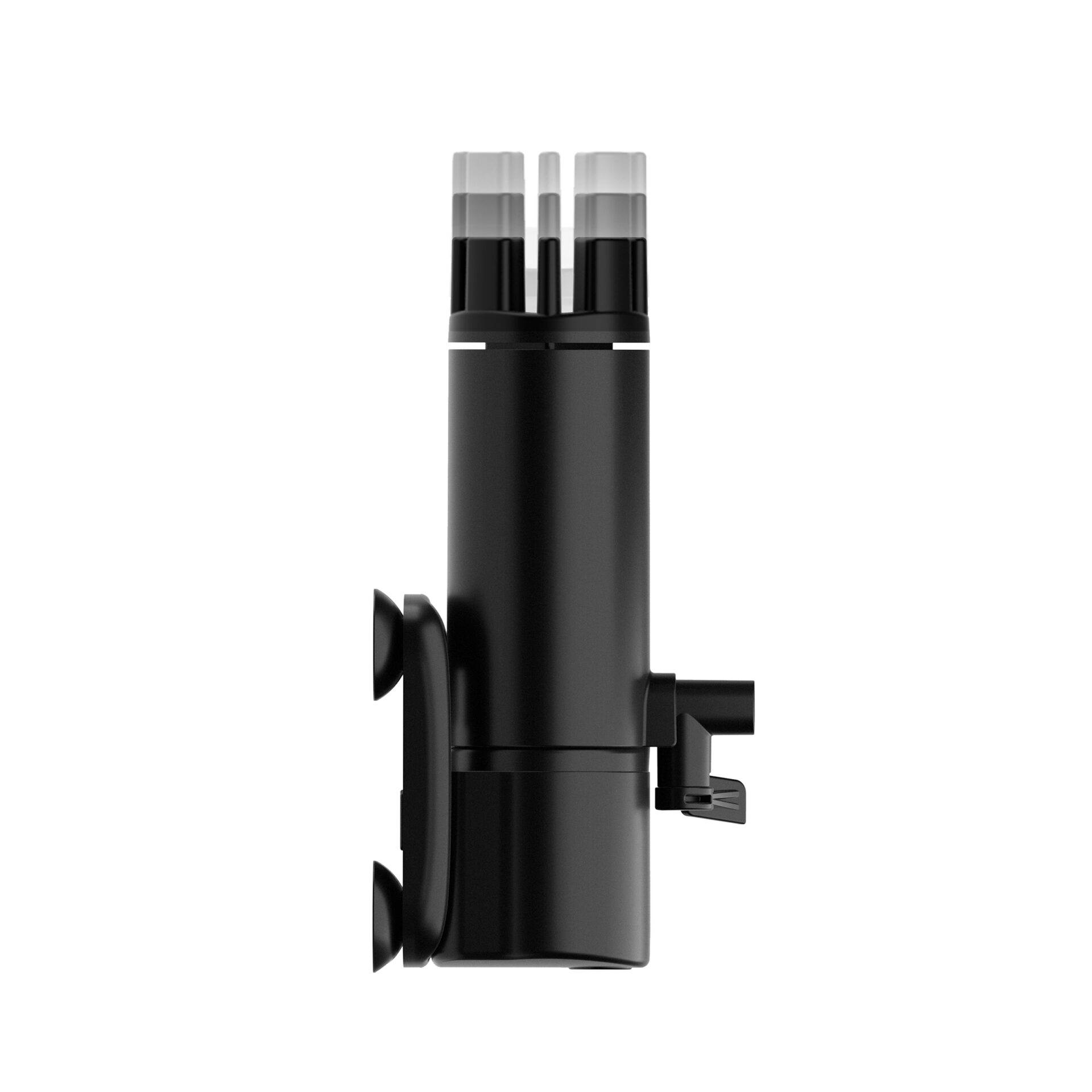
Your needs, this model
Does it fit your priorities?
Is the SAS 500 documented as a complete replacement for a general aquarium filter?
No such whole-tank replacement role is established by the sources inspected. Aquael describes it specifically as a surface filter for dust, protein film and small plant material, with a floating intake and sponge prefilter. Keep the broader filtration plan separate unless model-specific evidence supports more.
Explore this need in the finder →Does the SAS 500 need a canister cabinet below the aquarium?
No below-tank canister position is required: the manual shows the powered unit mounted inside the aquarium by a suction-cup holder, with the float projecting about 1–3 cm past the chamber. It still needs interior clearance, unobstructed surface access and room for sponge/impeller service. This product is reference-only because the exact US page says it is available soon in the USA.
Explore this need in the finder →Can the published SAS 500 volume and flow figures establish biological-load capacity?
No. Aquael lists a 5–130 US-gallon tank label, 4.4 W and maximum 130 US gal/h / 500 L/h with adjustment, but none is a fish-count, high-waste or litre-rated media-basket claim. The model page also says AVAILABLE SOON IN USA, and the US electrical edition and seller package are not established.
Explore this need in the finder →Aquael’s exact US-localized page identifies the SAS 500 FILTER as item 129896, but it also labels the model “AVAILABLE SOON IN USA.” The page supplies a model row and technical claims; it does not establish a current US seller offer or the package and electrical version a buyer would receive. This is therefore a reference assessment, not a current purchase recommendation, and it has no BuyerShortlists buying page.
A focused surface-filter task
Aquael describes the SAS 500 as a powered freshwater surface filter intended to collect dust, surface film and small plant material. Surface water passes through a floating intake and a dense sponge prefilter, where the maker says captured debris settles. That is a narrower job than the broad filtration role many shoppers mean by “an internal filter.” The product page does not document a litre-rated media basket, a high-waste rating or a full-tank biological-filtration plan. My assessment is to consider it for a specific surface-cleanup need only; do not infer from the word “filter” that it replaces the separate filtration plan for an aquarium.
The maker also says a sponge prefilter helps keep shrimp and small fish from entering the motor compartment, and that an animal that gets inside can be released by tilting the sleeve over the aquarium. Those are manufacturer descriptions, not independent animal-safety tests. The unit still needs observation in the actual tank and a maintenance routine that does not disturb livestock.
Read the flow and tank labels in context
The US page’s specifications pair a 5–130 US-gallon aquarium interval with 20–500 liters, 4.4 watts and maximum efficiency of 130 US gallons per hour / 500 liters per hour. Its prose says the adjustable controller can be set for tanks as small as 5 gallons. The linked English manual’s technical-data table shows the same 5–130 US-gallon and 20–500-liter interval, but one sentence above that table pairs 20–500 liters with “50–130 US gal.” I preserve that internal discrepancy rather than silently altering the manual. The exact US model page and the manual’s technical table agree on the 5-gallon lower label; these are maker ratings, not evidence that the surface skimmer is adequate as a sole filter for any particular stocking level.
Aquael describes continuously adjustable pump flow, so the listed maximum is not an installed aquarium-side measurement or a guaranteed minimum. The page does not quantify how much flow remains after the sponge is loaded, and it gives no fish-count or waste-load rule. The 130-gallon upper label must not be read as a biological-load guarantee. If your decision depends on litre-rated media capacity, a quantified high-load recommendation or an independently measured circulation rate, the reviewed sources do not answer it.
Placement depends on the floating intake
The manual shows the device mounted inside the aquarium with its supplied suction-cup holder. Its float must project about 1–3 cm beyond the filter chamber; that floating part is central to the design, not a decorative cap. Aquael says the float follows water-level changes such as evaporation. At first setup, the manual recommends starting with the flow control at its minimum to avoid drawing air into the unit, then adjusting the flow to the aquarium. Leave clear surface access for the float, space around the body for removal and cleaning, and a route to detach the suction-cup mount without scraping the glass. A crowded corner, cover geometry or floating plants could obstruct the surface intake; check the actual layout rather than assuming that an internal mounting point is enough.
Do not mistake this arrangement for a hang-on filter or an external canister. It needs room inside the tank and a reachable waterline, but no cabinet below the aquarium. The manual’s technical table lists a 12 mm outlet and a 150 cm cord. The exact US model page provides no body dimensions, so it cannot support a precise clearance drawing.
Maintenance is part of the design
Aquael recommends cleaning the sponge when performance declines and gives once a week, during a water change, as its routine interval. The same manual calls for regular cleaning of deposits from the impeller chamber. Disconnect the device before maintenance, remove it from the aquarium as instructed and return water from the sleeve to the tank. This makes the prefilter a recurring hands-on service point; it should not be treated as a maintenance-free surface solution. The manual is multilingual and states EU safety-standard language. It directs the user to the voltage on the device label, while the exact US page gives watts but no voltage or frequency. The claimed upcoming US availability does not prove that a particular seller box has a US-compatible electrical supply.
What this assessment can and cannot support
For a keeper comparing internal equipment, the SAS 500’s distinctive feature is its floating surface intake and foam prefilter, not a published basket capacity or a broad canister-like media arrangement. It is not interchangeable in purpose with the cartridge-panel Aquael Neo 300, whose model page describes a different internal filtering format and its own upper-only tank label. Neither product’s volume statement should be mistaken for a waste-load guarantee.
Before treating the SAS 500 as a future US option, verify that item 129896 has actually moved beyond “available soon,” then confirm the exact offer, included suction-cup mount and sponge, rated voltage/frequency on the unit, cord condition and the intended role alongside the aquarium’s other filtration. Aquael’s published figures and the manual are the basis for this analysis; no hands-on use, laboratory test, measured flow, price, retail stock or customer experience is claimed.
Primary sources: Aquael’s US-localized SAS 500 FILTER page and the linked multilingual SAS FILTER 500 manual (English section and technical table).
Key specifications
Key details at a glance
| Published range lower bound | 5 US gal |
|---|---|
| Published range upper bound | 130 US gal |
| US manufacturer item number | 129896 |
| Maximum listed flow rate (paired maker value) | 500 LPH |
| Adjustable flow control | Yes |
Use the exact model’s instructions for operating limits, supplied equipment and version differences.
Sources for this review
Sources for this assessment

Start with your tank and installation constraints
Compare supported tank-volume intervals, external versus internal arrangements, installation space and media needs. An upper-only capacity claim cannot establish a complete volume fit, and the finder cannot infer your fish load.